


Page 180 - (DK Eyewitness) Travel Guide: Japan
P. 180
178 JAP AN REGION B Y REGION
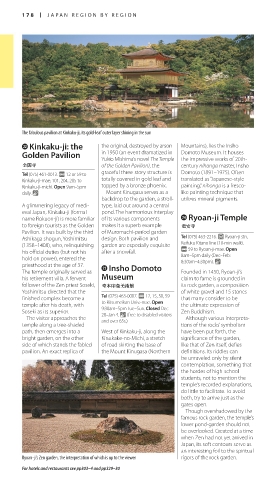
The fabulous pavilion at Kinkaku-ji, its gold-leaf outer layer shining in the sun
s Kinkaku-ji: the the original, des troyed by arson Mountains), lies the Insho
Golden Pavilion in 1950 (an event dramatized in Domoto Museum. It houses
Yukio Mishima’s novel The Temple
the impressive works of 20th-
Kinkakuji Temple century nihonga master, Insho
of the Golden Pavilion), the
Tel (075) 461-0013. @ 12 or 59 to graceful three-story structure is Domoto (1891–1975). Often
Kinkaku-ji-mae; 101, 204, 205 to totally covered in gold leaf and translated as “Japanese-style
Kinkaku-ji-michi. Open 9am–5pm topped by a bronze phoenix. painting,” nihonga is a fresco-
daily. & Mount Kinugasa serves as a like painting technique that
backdrop to the garden, a stroll- utilizes mineral pigments.
A glimmering legacy of medi- type, laid out around a central
eval Japan, Kinkaku-ji (formal pond. The harmonious interplay
name Rokuon-ji) is more familiar of its various components f Ryoan-ji Temple
to foreign tour ists as the Golden makes it a superb example Ryoanji Temple
Pavilion. It was built by the third of Muromachi-period garden
Ashikaga shogun, Yoshimitsu design. Both pavilion and Tel (075) 463-2216. £ Ryoan-ji stn,
(1358–1408), who, relinquish ing garden are especially exquisite Keifuku Kitano line (10-min walk).
@ 59 to Ryoan-ji-mae. Open
his official duties (but not his after a snowfall. 8am–5pm daily (Dec–Feb:
hold on power), entered the 8:30am–4:30pm). &
priesthood at the age of 37. d Insho Domoto
The temple originally served as Founded in 1450, Ryoan-ji’s
his retirement villa. A fervent Museum claim to fame is grounded in
its rock garden, a composition
follower of the Zen priest Soseki, Insho Domoto Museum
Yoshimitsu directed that the of white gravel and 15 stones
finished complex become a Tel (075) 463-0007. @ 12, 15, 50, 59 that many consider to be
to Ritsumeikan Univ.-mae. Open
temple after his death, with 9:30am–5pm Tue–Sun. Closed Dec the ultimate expression of
Soseki as its superior. 28–Jan 4. & (free to disabled visitors Zen Buddhism.
The visitor approaches the and over 65s.) Although various interpreta-
temple along a tree-shaded tions of the rocks’ symbolism
path, then emerges into a West of Kinkaku-ji, along the have been put forth, the
bright garden, on the other Kinukake-no-Michi, a stretch significance of the garden,
side of which stands the fabled of road skirting the base of like that of Zen itself, defies
pavilion. An exact replica of the Mount Kinugasa (Northern definitions. Its riddles can
be unraveled only by silent
contemplation, something that
the hordes of high-school
students, not to mention the
temple’s recorded explanations,
do little to facilitate. To avoid
both, try to arrive just as the
gates open.
Though overshadowed by the
famous rock garden, the temple’s
lower pond-garden should not
be overlooked. Created at a time
when Zen had not yet arrived in
Japan, its soft contours serve as
an interesting foil to the spiritual
Ryoan-ji’s Zen garden, the interpretation of which is up to the viewer rigors of the rock garden.
For hotels and restaurants see pp303–4 and pp329–30
178-179_EW_Japan.indd 178 08/08/16 3:07 pm
Eyewitness Travel LAYERS PRINTED:
Catalogue template “UK” LAYER
(Source v2.6)
Date 12th July 2013
Size 125mm x 217mm

