


Page 184 - (DK Eyewitness) Travel Guide: Japan
P. 184
182 JAP AN REGION B Y REGION
of the prince who designed is kept unaware until the last
Katsura Villa (see p180). Its minute of the panorama from
elegant build ings, with their the top of the Kitayama
cleverly crafted door pulls and mountains, spread out as if
other carefully planned details, an extension of the garden.
call to mind those of the
imperial villa. The beautiful
garden is composed of islands 9 Hieizan Enryaku-ji
of rock and vegetation amid
swaths of raked gravel, with the
Higashiyama mountains form- 4220 Sakamoto Honmachi, Otsu,
ing a harmonious backdrop. Shiga prefecture. Tel (077) 578-0001.
£ Yase-Hieizan-guchi stn, Eizan line,
then cable car; or Hieizan Sakamoto
8 Shugaku-in stn, Kosei line, then cable car. @
The upper garden at Shisen-do, as viewed
from the veranda Imperial Villa Enryaku-ji bus from Kyoto or Keihan
Sanjo stns. Open Mar–Nov: 8:30am–
6 Shisen-do Temple Shugaku-in Imperial Villa
4:30pm daily; Dec: 9am–4pm daily;
Yabuzoe, Shugaku-in. £ Shugaku-in Jan & Feb: 9am–4:30pm daily. &
Shisen-do Temple
stn, Eizan line. @ 5 to Shugaku-in A once mighty monastery
27 Monguchi-cho, Ichijo-ji, Sakyo-ku. Michi. Open by appt only Mon–Fri: fortress with 3,000 sub temples
Tel (075) 781-2954. @ 5 or 8 to Ichijo- apply at Imperial Household Agency, and thousands of sohei, or
ji Sagarimatsu-cho. Open 9am–5pm (075) 211-1215 (see p176). warrior monks, Hieizan today
daily. &
If Katsura Villa (see p180) could is but a shadow of its former
A samurai who had fallen out be said to be yin, then its self. Still, the solemnity of its
of favor with the shogun ate, counterpart imperial villa, isolated mountain-top setting
Ishikawa Jozan, construct ed Shugaku-in, could only be and grandeur of its remaining
this retirement villa in 1641. described as yang. While the buildings make the trek to
On a small plot below the former’s garden, layered with Mount Hiei worthwhile.
Higashiyama mountains, this literary and poetic allusions, is Founded by the monk Saicho
Confucian scholar and poet characterized by an inward- in 792, Hieizan became the
succeeded in creating a nearly looking sensibility, spacious main monastery of the Tendai
perfect blend of building and Shugaku-in might strike the sect (see p279). Although
garden. Although now a Soto- viewer as extroverted. initially entrusted to protect
sect Zen temple, the hermitage Created by retired emperor the city from evil forces, the
retains the feel of a home. Go-Mizunoo (1596–1680), the area itself became the bane
The famous garden is divid ed garden was a lifetime labor of of the capital. Emperor
into two levels: the upper, best love. Divided into three levels, Go-Shirakawa (1127–92)
viewed from the main building’s each with a teahouse, the com- once lamented that there
veranda, features a broad expanse plex is imbued with a spirit of were only three things beyond
of packed sand bordered by understated simplicity. Yet, a his control: the flooding of
clipped azalea bushes. The surprise awaits: the approach the Kamo River, the roll of
lower level, which also makes to the uppermost teahouse the dice, and the warrior
use of areas of sand to add light is designed so that the visitor monks of Hieizan. In 1571,
and space, offers a fine view of
the villa’s tile-and-thatch roof
and moon-viewing chamber.
7 Manshu-in
Temple
Manshu-in Temple
42 Takenouchi-cho, Ichijo-ji, Sakyo-ku.
Tel (075) 781-5010. @ 5 to Ichijoji-
Shimizu-cho. Open 9am–4:30pm
daily. &
Even in spring and fall when its
cherries and maples draw the
crowds, Manshu-in maintains an
atmosphere of dignified repose.
This Tendai-sect temple was
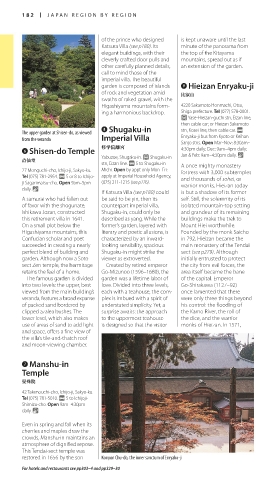
restored in 1656 by the son Konpon Chu-do, the inner sanctum of Enryaku-ji
For hotels and restaurants see pp303–4 and pp329–30
182-183_EW_Japan.indd 182 08/08/16 4:28 pm

