


Page 244 - (DK Eyewitness) Travel Guide: Japan
P. 244
242 JAP AN REGION B Y REGION
8 Kurume
Kurume
Fukuoka prefecture. * 305,000. £
n (0942) 31-1717. _ Suiten-gu
Spring Festival (May 3–7); Mizu-no-
Saiten (water festival, Aug 3–5).
The unattractive, sprawling city
of Kurume is the center of kasuri
textiles. These employ a distinctive
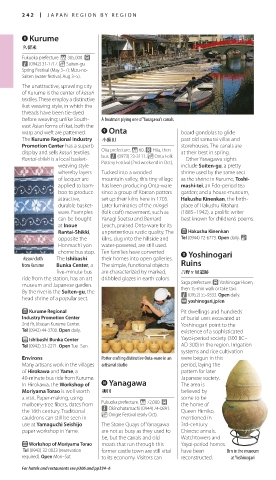
ikat weav ing style, in which the
threads have been tie-dyed
before weaving; unlike South- A boatman plying one of Yanagawa’s canals
east Asian forms of ikat, both the
warp and weft are patterned. 9 Onta board gondolas to glide
The Kurume Regional Industry Onta past old samurai villas and
Promotion Center has a superb storehouses. The canals are
display and sells kasuri textiles. Oita prefecture. * 60. £ Hita, then at their best in spring.
bus. n (0973) 23-3111. _ Onta Folk
Rantai-shikki is a local basket- Pottery Festival (2nd weekend in Oct). Other Yanagawa sights
weaving style in clude Suiten-gu, a pretty
whereby layers Tucked into a wooded shrine used by the same sect
of lacquer are mountain valley, this tiny village as the shrine in Kurume; Toshi-
applied to bam- has been producing Onta-ware mashi-tei, an Edo-period tea
boo to produce since a group of Korean potters garden; and a house-museum,
attractive, set up their kilns here in 1705. Hakushu Kinenkan, the birth-
durable basket- Later lumi naries of the mingei place of Hakushu Kitahara
ware. Examples (folk craft) movement, such as (1885–1942), a prolific writer
can be bought Yanagi Soetsu and Bernard best known for children’s poems.
at Inoue Leach, praised Onta-ware for its
Rantai-Shikki, un pretentious rustic quality. The E Hakushu Kinenkan
opposite the kilns, dug into the hillside and Tel (0944) 72-6773. Open daily. &
Honmachi-yon- water-powered, are still used.
chome bus stop. Ten families have con verted q Yoshinogari
Kasuri cloth The Ishibashi their homes into open galleries.
from Kurume Bunka Center, a The simple, functional objects Ruins
five-minute bus are characterized by marked, Yoshinogari Achaeological Site
ride from the station, has an art dribbled glazes in earth colors.
museum and Japanese garden. Saga prefecture. £ Yoshinogari-koen,
then 15-min walk or take taxi.
By the river is the Suiten-gu, the n (0952) 55-9333. Open daily.
head shrine of a popular sect. ∑ yoshinogari.jp/en
E Kurume Regional Pit dwellings and hundreds
Industry Promotion Center of burial urns excavated at
2nd flr, Jibasan Kurume Center. Yoshinogari point to the
Tel (0942) 44-3700. Open daily. existence of a sophisticated
P Ishibashi Bunka Center Yayoi-period society (300 BC–
Tel (0942) 33-2271. Open Tue–Sun. AD 300) in the region. Irrigation
systems and rice cultivation
Environs Potter crafting distinctive Onta-ware in an were begun in this
Many artisans work in the villages artisanal studio period, laying the
of Hirokawa and Yame, a pattern for later
40-minute bus ride from Kurume. Japanese society.
In Hirokawa, the Workshop of 0 Yanagawa The area is
Moriyama Torao is well worth Yanagawa believed by
a visit. Paper-making, using some to be
mulberry-tree fibers, dates from Fukuoka prefecture. * 72,000. £ the home of
n Okinohatamachi (0944) 74-0891.
the 16th century. Traditional _ Onigie Festival (early Oct). Queen Himiko,
cauldrons can still be seen in mentioned in
use at Yamaguchi Seishijo The Stone Quays of Yana gawa 3rd-century
paper workshop in Yame. are not as busy as they used to Chinese annals.
be, but the canals and old Watch towers and
E Workshop of Moriyama Torao moats that run through this Yayoi-period homes
Tel (0943) 32-0023 (reservation former castle town are still vital have been Urn in the museum
required). Open Mon–Sat. to its economy. Visitors can re constructed. at Yoshinogari
For hotels and restaurants see p306 and pp334–6
242-243_EW_Japan.indd 242 08/08/16 2:54 pm

