


Page 246 - (DK Eyewitness) Travel Guide: Japan
P. 246
244 JAP AN REGION B Y REGION
e Nagasaki
Nagasaki
A history of contact and interaction with Europe, its tragic
fate as victim of the second atomic bomb, and miraculous
resurgence since the war have made Nagasaki one of the
most cosmopolitan and eclectic cities in Japan. After the
Portuguese were expelled from the country in 1638, the
Dutch, confined to the tiny island of Dejima, were the only
foreign power permitted to remain throughout Japan’s long
period of self-imposed isolation. When Japan opened its
doors to foreigners in 1854, Nagasaki thrived once more
as a center of Western trade and culture.
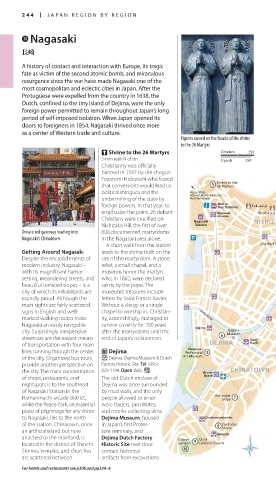
Figures carved on the facade of the shrine
to the 26 Martyrs
5 Shrine to the 26 Martyrs 0 meters 250
5-min walk N of stn. 0 yards 250
Christianity was officially
banned in 1597 by the shogun
Toyotomi Hideyoshi who feared Shrine to the
that conversions would lead to 26 Martyrs
political intrigues and the Peace Park, Suwa Shrine
Atomic Bomb Museum,
undermining of the state by Huis ten Bosch
foreign powers. In that year, to Ken-ei Fukusai-ji
Bus Terminal
emphasize the point, 26 defiant Nagasaki- Shofuku-ji
Christians were crucified on Nagasaki eki-mae NISHIZ AKA Suwa-
Nishizaka Hill, the first of over Station Nagasaki Museum jinja-mae
Ornate red gateway leading into 600 documented martyrdoms of History and Culture
Nagasaki’s Chinatown in the Nagasaki area alone.
A short walk from the station City Hall
Getting Around Nagasaki leads to the shrine built on the
Despite the encroachments of site of the martyrdom. A stone
modern industry, Nagasaki – relief, a small chapel, and a Nakashima River
with its magnificent harbor museum honor the martyrs Kofuku-ji
Temple
setting, meandering streets, and who, in 1862, were declared
beautiful terraced slopes – is a saints by the pope. The
city of which its inhabitants are museum’s treasures include
roundly proud. Although the letters by Saint Francis Xavier. Spectacles
Bridge
main sights are fairly scattered, Without a clergy or a single
signs in English and well- chapel to worship in, Christian- Oura River KANKO-DORI TERAMACHI-DORI
marked walking routes make ity, astonishingly, managed to
Nagasaki an easily navigable survive covertly for 200 years Dejima
Dejima
city. Sur prisingly inexpensive after the martyrdoms until the Museum HAMANOMACHI Daion-ji
Temple
street cars are the easiest means end of Japan’s isolationism. Tsuki-
of transportation with four main DEJIMA machi Shianbashi
Nagasaki
lines running through the center E Dejima Prefectural SHIANBASHI Sofuku-ji
of the city. Organized bus tours v Dejima. Dejima Museum & Dutch Art Museum Temple
provide another perspective on Fac tory Historic Site: Tel (095) Shokaku-ji-shita
the city. The main concentration 829-1194. Open daily. & Shimin CHINATOWN
of shops, restaurants, and The old Dutch enclave of Byoin
nightspots is to the southeast Dejima was once surroun ded
of Nagasaki Station in the by mud walls, and the only
Hamanmachi arcade district, people allowed to enter Hollander
Slope
while the Peace Park, an essential were traders, prosti tutes,
place of pilgrimage for any visitor and monks collecting alms.
to Nagasaki, lies to the north Dejima Museum, housed Ouratenshudoshita
of the station. Chinatown, once in Japan’s first Prot es- Confucius
Shrine
an artificial island but now tant sem inary, and Ishibashi
attached to the mainland, is Dejima Dutch Factory Glover Oura
located in the district of Shinchi. Historic Site next door Garden Catholic Church
Shrines, temples, and churches contain historical
are scattered between. artifacts from exca vations
For hotels and restaurants see p306 and pp334–6
244-245_EW_Japan.indd 244 08/08/16 3:08 pm
Eyewitness Travel LAYERS PRINTED:
Catalogue template “UK” LAYER
(Source v2.6)
Date 12th July 2013
Size 125mm x 217mm

