


Page 245 - (DK Eyewitness) Travel Guide: Japan
P. 245
K YUSHU 243
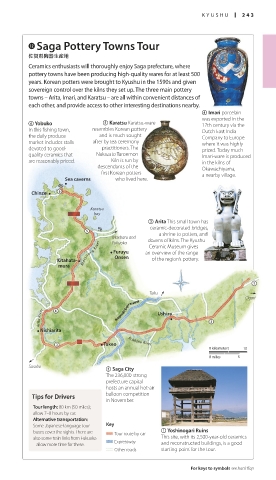
w Saga Pottery Towns Tour
Ceramics enthusiasts will thoroughly enjoy Saga prefecture, where
pottery towns have been producing high-quality wares for at least 500
years. Korean potters were brought to Kyushu in the 1590s and given
sovereign control over the kilns they set up. The three main pottery
towns – Arita, Imari, and Karatsu – are all within convenient distances of
each other, and provide access to other interesting destinations nearby.
4 Imari porcelain
was ex ported in the
6 Yobuko 5 Karatsu Karatsu-ware 17th century via the
In this fishing town, resembles Korean pottery Dutch East India
the daily produce and is much sought Company to Europe
market includes stalls after by tea ceremony where it was highly
devoted to good- practitioners. The prized. Today much
quality ceramics that Nakazato Taroemon Imari-ware is produced
are reasonably priced. Kiln is run by in the kilns of
descendants of the Okawachiyama,
first Korean potters a nearby village.
Sea caverns who lived here.
J
Chinzei
Karatsu
bay
3 Arita This small town has
ceramic-decorated bridges,
J
a shrine to potters, and
Maebaru and dozens of kilns. The Kyushu
Matsuur a River Furuyu an overview of the range
Fukuoka
Ceramic Museum gives
Kitahata- Onsen of the region’s pottery.
mura
Taku
Ogori
Arita River Nagasaki Expressway Ushizu •
Nishiarita
Takeo Rokkaku River
0 kilometers 10
0 miles 5
Sasebo
2 Saga City
The 236,000-strong
prefecture capital
hosts an annual hot-air
Tips for Drivers balloon competition
in November.
Tour length: 80 km (50 miles);
allow 7–8 hours by car.
Alternative transportation:
Some Japanese-language tour Key
buses cover the sights. There are Tour route by car 1 Yoshinogari Ruins
also some train links from Fukuoka Expressway This site, with its 2,500-year-old cera mics
– allow more time for these. and reconstructed buildings, is a good
Other roads starting point for the tour.
For keys to symbols see back flap
242-243_EW_Japan.indd 243 08/08/16 2:54 pm

