


Page 248 - (DK Eyewitness) Travel Guide: Japan
P. 248
246 JAP AN REGION B Y REGION
Exploring Nagasaki 5 Oura Catholic Church
v Oura Tenshudo Shita. &
To the north and south of the city center there are many This white church was built in
sights of interest, most of them reflecting the diverse foreign 1864 under the direction of
influences that have shaped Nagasaki. For a view of the city Bernard Petitjean, a French
take a boat trip from Ohato Pier, or, better still, cross the priest who became the
harbor and take the ropeway to the lookout tower on the first Bishop of Nagasaki.
The church, which boasts
summit of Mount Inasa. some impressive stained-glass
windows, was erected in order
to serve the foreign community
that settled in Nagasaki after the
new trade treaties were signed.
It was also intended to honor
the city’s 26 martyred saints.
Short ly after its foundation,
Father Petitjean was approached
by members of a group of
Japanese Christians who had
practiced their faith in secret
and at risk for over 200 years.
Classed as a National Treasure,
Oura is one of the oldest
churches in Japan and the
country’s earliest Gothic
wooden structure. A wooden
building beside the church
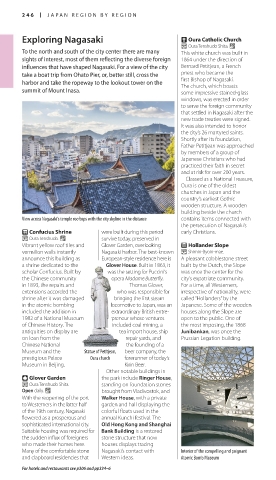
View across Nagasaki’s temple rooftops with the city skyline in the distance contains items connected with
the persecution of Nagasaki’s
Confucius Shrine were built during this period early Christians.
v Oura Tenshudo. & survive today, preserved in
Vibrant yellow roof tiles and Glover Garden, overlooking E Hollander Slope
vermilion walls instantly Nagasaki harbor. The best-known v Shimin-Byoin-mae.
announce this building as European-style residence here is A pleasant cobblestone street
a shrine dedicated to the Glover House. Built in 1863, it built by the Dutch, the Slope
scholar Confucius. Built by was the setting for Puccini’s was once the center for the
the Chinese community opera Madame Butterfly. city’s expatriate community.
in 1893, the repairs and Thomas Glover, For a time, all Westerners,
extensions accorded the who was responsible for ir respective of nationality, were
shrine after it was damaged bring ing the first steam called “Hollanders” by the
in the atomic bombing loco motive to Japan, was an Japanese. Some of the wood en
included the addition in extraordinary British entre- houses along the Slope are
1982 of a National Museum preneur whose ventures open to the public. One of
of Chinese History. The included coal mining, a the most imposing, the 1868
antiquities on display are tea import house, ship Junibankan, was once the
on loan from the repair yards, and Prussian Legation building.
Chinese National the founding of a
Museum and the Statue of Petitjean, beer company, the
prestigious Palace Oura church forerunner of today’s
Museum in Beijing. Kirin Beer.
Other notable buildings in
Y Glover Garden the park include Ringer House,
v Oura Tenshudo Shita. standing on founda tion stones
Open daily. & brought from Vladivostok, and
With the reopening of the port Walker House, with a private
to Westerners in the latter half garden and hall displaying the
of the 19th century, Naga saki color ful floats used in the
flowered as a prosperous and annual Kunchi festival. The
sophisticated interna tional city. Old Hong Kong and Shanghai
Suitable housing was required for Bank Building is a restored
the sudden influx of foreigners stone structure that now
who made their homes here. houses displays tracing
Many of the comfortable stone Nagasaki’s contact with Interior of the compelling and poignant
and clap board residencies that Western ideas. Atomic Bomb Museum
For hotels and restaurants see p306 and pp334–6
246-247_EW_Japan.indd 246 08/08/16 3:08 pm
Eyewitness Travel LAYERS PRINTED:
Catalogue template “UK” LAYER
(Source v2.6)
Date 12th July 2013
Size 125mm x 217mm

