


Page 261 - (DK Eyewitness) Travel Guide: Japan
P. 261
OKINA W A 259
surren der to advanc- 4 Gyokusendo
ing American forces. Cave
Cape Kyan saw Gyokusendo Cave
some of the fiercest
exchanges. Many 30 km (19 miles) SW of Naha.
locals jumped to their
deaths here. To the Japan’s largest stalactite grottoes
northeast, the were discovered in 1967 by
Himeyuri no To students from Ehime University.
Monument and the With over 460,000 stalactites, this
Himeyuri Peace natural fantasia is negotiated
Museum are much- with the help of rather slippery
visited mem orials to a pathways and wooden walk-
group of schoolgirls ways. The stalac tites have been
and tea chers who died likened to giant bamboo, wine
while working as vol- glasses, organ pipes, and statues
unteer nurses during by Rodin. At the center is a
the Battle of Okinawa. pond known as Golden Cup.
A total of 136 people The cave can be viewed
died inside a cave by visiting Okinawa World,
while trying to escape a park and museum with a
from the carnage. large snake collection, inclu-
Most perished from ding the habu, Okinawa’s
Cliffs at Cape Kyan, also called Cape of Tragedy the effects of a gas most poisonous reptile.
bomb fired into the
2 The Former cavern, others com mitted suicide. P Okinawa World
Japanese Navy Konpaku no To, 2 km (1 mile) Tel (098) 949-7421.
Underground HQ south, is a cliffside memorial Open 9am–6pm daily. &
where 35,000 unknown soldiers
Imperial Navy Underground HQ
and civilians were interred.
5 km (3 miles) S of Naha. @ from Naha One of the heaviest losses of
bus terminal to Tomigusuku Koen-mae. life was on Mabuni Hill. Now a
Tel (098) 850-4055. Open 8:30am–5pm memorial park, it is dotted with
daily (Jul–Sep: 8:30am–5:30pm). & monuments dedi cated to both
military and civilian dead. A
Parts of the subterranean rooms display of photos, memorabilia,
and tunnels where the Japanese and personal accounts of the
Navy conducted the closing battle can be seen at the nearby
stages of World War II have Peace Memorial Museum.
been restored and opened to
the public. The Imperial Navy P Peace Memorial Museum
Admiral was one of over 4,000 Tel (098) 997-3844. Open 9am–5pm Densely packed stalactites in
men who committed suicide daily. Closed Dec 29–Jan 3. & Okinawa World
here on June 13, 1945. Many
of the officers dispatched
themselves by seppuku (ritual The Battle of Okinawa
disembowel ment); others used Few conflicts in modern history have
hand grenades – scorch marks been fought with such fero city on both
can still be seen on tunnel walls. sides as the Battle of Okinawa. The final
phase in the Pacific War began when
five American divisions, supported by a
3 Okinawa massive aerial and naval bombard ment,
landed on Easter Sunday, April 1, 1945.
Battle Sites Although logistically outnumbered,
Okinawa Battle Sites the Japanese were well prepared
for the attack with a maze of tunnels
15 km (9 miles) S of Naha. @ bus tour and shelters. The horrors of these
from Naha recommended. engagements, utilizing flame-throwers,
grenades, bayonets, and kamikaze pilots
At the southern end of Okinawa, (Japanese suicide bombers), almost
the scene of the heaviest fighting defies imagination. By the end of the
at the close of World War II, are battle, which lasted 82 days, 13,000
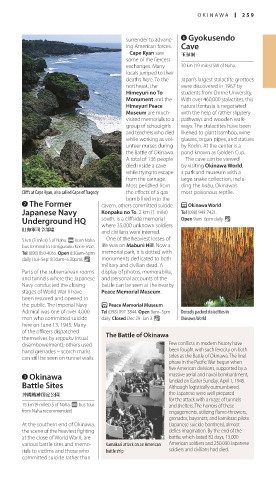
various battle sites and memo- Kamakazi attack on an American American soldiers and 250,000 Japanese
rials to victims and those who battle ship soldiers and civilians had died.
committed suicide rather than
258-259_EW_Japan.indd 259 08/08/16 4:08 pm

