


Page 263 - (DK Eyewitness) Travel Guide: Japan
P. 263
OKINA W A 261
Okinawan Arts and Crafts
Okinawan artists and craftsmen are
honored as masters or, in a few rare
cases, Living National Treasures. The
island’s textiles are among the finest
in Japan, particularly the linen-dyed
bingata and ryusen fabrics, bashofu,
and kasuri, a high-quality cloth
made from the finest natural fibers.
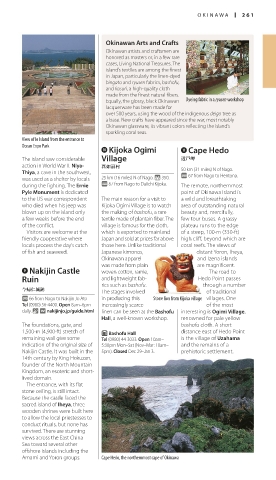
Equally, the glossy, black Okinawan Dyeing fabric in a ryusen workshop
lacquerware has been made for
over 500 years, using the wood of the indigenous deigo tree as
a base. New crafts have appeared since the war, most notably
Okinawan glassware, its vibrant colors reflecting the island’s
sparkling coral seas.
View of Ie Island from the entrance to
Ocean Expo Park
0 Kijoka Ogimi q Cape Hedo
The island saw considerable Village Hedo Misaki Cape
action in World War II. Niya- Kijoka Village
50 km (31 miles) N of Nago.
Thiya, a cave in the southwest, @ 67 from Nago to Hentona.
was used as a shelter by locals 25 km (16 miles) N of Nago. * 350.
during the fighting. The Ernie @ 67 from Nago to Daiichi Kijoka. The remote, northernmost
Pyle Monument is dedicated point of Okinawa Island is
to the US war correspondent The main reason for a visit to a wild and breathtaking
who died when his jeep was Kijoka Ogimi Village is to watch area of outstanding natural
blown up on the island only the making of bashofu, a rare beauty and, mercifully,
a few weeks before the end textile made of plantain fiber. The few tour buses. A grassy
of the conflict. village is famous for the cloth, plateau runs to the edge
Visitors are welcome at the which is exported to mainland of a steep, 100-m (330-ft)
friendly cooperative where Japan and sold at prices far above high cliff, beyond which are
locals process the day’s catch those here. Unlike traditional coral reefs. The views of
of fish and seaweed. Japanese kimonos, distant Yoron, Iheya,
Okinawan apparel and Izena islands
was made from plain are magnificent.
9 Nakijin Castle woven cotton, ramie, The road to
Ruin and lightweight fab- Hedo Point passes
rics such as bashofu. through a number
Nakijin Castle Ruin of traditional
The stages involved
@ 66 from Nago to Nakijin Jo Ato in producing this Stone lion from Kijoka village villages. One
Tel (0980) 56-4400. Open 8am–6pm increasingly scarce of the most
daily. & ∑ nakijinjo.jp/guide.html linen can be seen at the Bashofu interesting is Ogimi Village,
Hall, a well-known workshop. renowned for pale yellow
The foundations, gate, and bashofu cloth. A short
1,500-m (4,900-ft) stretch of E Bashofu Hall distance east of Hedo Point
remaining wall give some Tel (0980) 44-3033. Open 10am– is the village of Uzahama
indication of the original size of 5:30pm Mon–Sat (Nov–Mar: 10am– and the remains of a
Nakijin Castle. It was built in the 5pm). Closed Dec 29–Jan 3. prehistoric settlement.
14th century by King Hokuzan,
founder of the North Mountain
Kingdom, an esoteric and short-
lived domain.
The entrance, with its flat
stone ceiling, is still intact.
Because the castle faced the
sacred island of Iheya, three
wooden shrines were built here
to allow the local priest esses to
conduct rituals, but none has
survived. There are stunning
views across the East China
Sea toward several other
offshore islands including the
Amami and Yoron groups. Cape Hedo, the northernmost cape of Okinawa
260-261_EW_Japan.indd 261 08/08/16 3:08 pm

