


Page 264 - (DK Eyewitness) Travel Guide: Japan
P. 264
262 JAP AN REGION B Y REGION
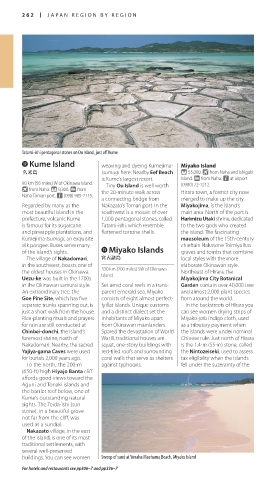
Tatami-ishi pentagonal stones on Ou Island, just off Kume
w Kume Island weaving and dyeing Kume jima- Miyako Island
Kume Island * 55,000. k from Naha and Ishigaki
tsumugi here. Nearby Eef Beach
is Kume’s largest resort. Island. g from Naha. n at airport
90 km (56 miles) W of Okinawa Island. Tiny Ou Island is well worth (0980) 72-1212.
k from Naha. * 9,300. g from
Naha Tomari port. n (098) 985-7115. the 20-minute walk across Hirara town, a former city now
a connecting bridge from merged to make up the city
Regarded by many as the Nakazato’s Tomari port. In the Miyakojima, is the island’s
most beautiful island in the southwest is a mosaic of over main area. North of the port is
prefecture, volcanic Kume 1,000 pentagonal stones, called Harimizu Utaki shrine, dedicated
is famous for its sugarcane Tatami-ishi, which resemble to the two gods who created
and pineapple plantations, and flattened tortoise shells. the island. The fascinating
Kumejima-tsumugi, an exqui site mausoleum of the 15th-century
silk pongee. Buses serve many e Miyako Islands chieftain Nakasone Toimiya has
of the island’s sights. graves and tombs that combine
The village of Nakadomari, Miyako Islands
local styles with the more
in the southwest, boasts one of elaborate Okinawan style.
the oldest houses in Okinawa. 330 km (200 miles) SW of Okinawa Northeast of Hirara, the
Island.
Uezu-ke was built in the 1700s Miyakojima City Botanical
in the Okinawan samurai style. Set amid coral reefs in a trans- Garden contain over 40,000 tree
An extraordi nary tree, the parent emerald sea, Miyako and almost 2,000 plant species
Goe Pine Site, which has five consists of eight almost perfect- from around the world.
separate trunks spanning out, is ly flat islands. Unique customs In the backstreets of Hirara you
just a short walk from the house. and a distinct dialect set the can see women drying strips of
Rice-planting rituals and prayers inhabitants of Miyako apart Miyako-jofu indigo cloth, used
for rain are still conducted at from Okinawan mainlanders. as a tributary payment when
Chinbei-donchi, the island’s Spared the devastation of World the islands were under nominal
foremost shrine, north of War II, traditional houses are Chinese rule. Just north of Hirara
Nakadomari. Nearby, the sac red squat, one-story buildings with is the 1.4-m (55-in) stone, called
Yajiya-gama Caves were used red-tiled roofs and sur rounding the Nintozeiseki, used to assess
for burials 2,000 years ago. coral walls that serve as shelters tax eligibility when the islands
To the north, the 200-m against typhoons. fell under the suzerainty of the
(650-ft) high Hiyajo Banta cliff
affords good views toward the
Aguni and Tonaki islands and
the barrier reef below, one of
Kume’s outstanding natural
sights. The Teida-ishi (sun
stone), in a beautiful grove
not far from the cliff, was
used as a sundial.
Nakazato village, in the east
of the island, is one of its most
traditional settlements, with
several well-preserved
buildings. You can see women Sweep of sand at Yonaha Maehama Beach, Miyako Island
For hotels and restaurants see pp306–7 and pp336–7
262-263_EW_Japan.indd 262 08/08/16 3:08 pm
Eyewitness Travel LAYERS PRINTED:
Catalogue template “UK” LAYER
(Source v2.6)
Date 12th July 2013
Size 125mm x 217mm

