


Page 285 - (DK Eyewitness) Travel Guide: Japan
P. 285
NOR THERN HONSHU 283
o Hirosaki Twenty-two temples
line the approach to
Chosho-ji, the family
Hirosaki
Aomori prefecture. * 175,000. £
n Hirosaki stn (0172) 26-3600. temple of the
Tsugaru, about
_ Neputa Matsuri (Aug 1–7).
∑ hirosaki-kanko.or.jp/en/ a 15-minute walk
southwest of the
Long the cultural and edu- park, built on a bluff
cational center of Aomori, overlooking the
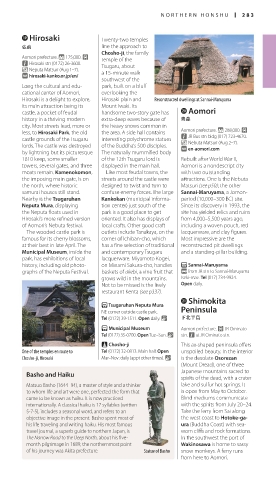
Hirosaki is a delight to explore, Hirosaki plain and Reconstructed dwellings at Sannai-Maruyama
its main attraction being its Mount Iwaki. Its
castle, a pocket of feudal handsome two-story gate has p Aomori
his tory in a thriving modern extra-deep eaves because of Aomori
city. Most streets lead, more or the heavy snows common in
less, to Hirosaki Park, the old the area. A side hall contains Aomori prefecture. * 288,000. £
n JR Bus stn bldg (017) 723-4670.
castle grounds of the Tsugaru interesting polychrome statues _ Nebuta Matsuri (Aug 2–7).
lords. The castle was destroyed of the Buddha’s 500 disciples. ∑ en-aomori.com
by lightning but its picturesque The naturally mummified body
1810 keep, some smaller of the 12th Tsugaru lord is Rebuilt after World War II,
tow ers, several gates, and three displayed in the main hall. Aomori is a nondescript city
moats remain. Kamenoko mon, Like most feudal towns, the with two outstanding
the imposing main gate, is on streets around the castle were attractions. One is the Nebuta
the north, where historic designed to twist and turn to Matsuri (see p50); the other
samurai houses still stand. confuse enemy forces. The large Sannai-Maruyama, a Jomon-
Nearby is the Tsugaruhan Kankokan (municipal informa- period (10,000–300 BC) site.
Neputa Mura, displaying tion center) just south of the Since its discovery in 1993, the
the Neputa floats used in park is a good place to get site has yielded relics and ruins
Hirosaki’s more refined version oriented. It also has dis plays of from 4,000–5,500 years ago,
of Aomori’s Nebuta festival. local crafts. Other good craft including a woven pouch, red
The wooded castle park is outlets include Tanakaya, on the lacquerware, and clay figures.
famous for its cherry blossoms, corner of Ichiban-cho, which Most impressive are the
at their best in late April. The has a fine selection of traditional reconstructed pit dwellings
Municipal Mus eum, inside the and contemporary Tsugaru and a standing-pillar building.
park, has exhibitions of local lacquerware. Miyamoto Kogei,
history, including old photo- on Minami Sakura-cho, handles P Sannai-Maruyama
graphs of the Neputa Festival. baskets of akebi, a vine fruit that @ from JR stn to Sannai-Maruyama
grows wild in the mountains. Iseki-mae. Tel (017) 734-9924.
Not to be missed is the lively Open daily.
restaurant Kenta (see p337).
a Shimokita
P Tsugaruhan Neputa Mura
NE corner outside castle park. Peninsula
Tel (0172) 39-1511. Open daily. & Shimokita Peninsula
P Municipal Museum Aomori prefecture. £ JR Ominato
Tel (0172) 35-0700. Open Tue–Sun. & stn. n at JR Ominato stn.
Chosho-ji This ax-shaped peninsula offers
One of the temples en route to Tel (0172) 32-0813. Main hall: Open unspoiled beauty. In the interior
Chosho-ji, Hirosaki Mar–Nov: daily (appt other times). & is the desolate Osorezan
(Mount Dread), one of three
Basho and Haiku Japanese mountains sacred to
spirits of the dead, with a crater
Matsuo Basho (1644–94), a master of style and a thinker lake and sulfur hot springs. It
to whom life and art were one, perfected the form that is open from May to October.
came to be known as haiku. It is now practiced Blind medi ums communicate
internationally. A classical haiku is 17 syllables (written with the spirits from July 20–24.
5-7-5), includes a seasonal word, and refers to an Take the ferry from Sai along
objective image in the present. Basho spent most of the west coast to Hotoke-ga-
his life traveling and writing haiku. His most famous ura (Buddha Coast) with sea-
travel journal, a superb guide to northern Japan, is worn cliffs and rock formations.
The Narrow Road to the Deep North, about his five- In the southwest the port of
month pil grimage in 1689; the northernmost point Wakinosawa is home to sassy
of his journey was Akita prefecture. Statue of Basho snow monkeys. A ferry runs
from here to Aomori.
282-283_EW_Japan.indd 283 08/08/16 3:09 pm

