


Page 281 - (DK Eyewitness) Travel Guide: Japan
P. 281
NOR THERN HONSHU 279
Buddhist Sects
In the course of 1,500 years or so, since the time that priests from mainland Asia first
brought Buddhism (see pp32–3) to Japan, hundreds of sepa rate Buddhist movements,
sects, and subsects developed in the country. Contrasting beliefs appealed to different
groups of nobility, samurai, and commoners, who each adapted practices to their own
ends. In the eyes of many foreigners today, Zen, one-time favorite of the samurai, is the
quintessential religion of Japan, but it is just one of several major movements originating
in China, and is itself subdivided into various sects. Of other movements flowering in
Japan, the Tendai and Shingon sects of esoteric Buddhism still have millions of devotees.
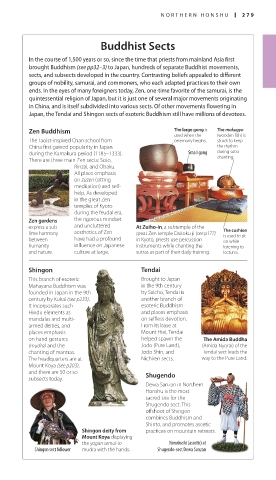
Zen Buddhism The large gong is The mokugyo
used when the (wooden fish) is
The Taoist-inspired Chan school from ceremony begins. struck to keep
China first gained popularity in Japan the rhythm
during the Kamakura period (1185–1333). Small gong during sutra
chanting.
There are three main Zen sects: Soto,
Rinzai, and Obaku.
All place emphasis
on zazen (sitting
meditation) and self-
help. As developed
in the great Zen
temples of Kyoto
during the feudal era,
Zen gardens the rig orous mindset
express a sub- and uncluttered At Zuiho-in, a subtemple of the The cushion
lime harmony aesthe tics of Zen great Zen temple Daitoku-ji (see p177) is used to sit
between have had a profound in Kyoto, priests use percussion on while
human ity influence on Japan ese instru ments while chanting the listening to
and nature. culture at large. sutras as part of their daily training. lectures.
Shingon Tendai
This branch of esoteric Brought to Japan
Mahayana Buddhism was in the 9th century
founded in Japan in the 9th by Saicho, Tendai is
century by Kukai (see p233). another branch of
It incorporates such esoteric Buddhism
Hindu elements as and places emphasis
mandalas and multi- on selfless devotion.
armed deities, and From its base at
places emphasis Mount Hiei, Tendai
on hand gestures helped spawn the The Amida Buddha
(mudra) and the Jodo (Pure Land), (Amida Nyorai) of the
chanting of mantras. Jodo Shin, and Tendai sect leads the
The headquarters are at Nichiren sects. way to the Pure Land.
Mount Koya (see p203),
and there are 50 or so Shugendo
subsects today.
Dewa Sanzan in Northern
Honshu is the most
sacred site for the
Shugendo sect. This
offshoot of Shingon
combines Buddhism and
Shinto, and promotes ascetic
Shingon deity from practices on mountain retreats.
Mount Koya display ing
the yogan semui-in Yamabushi (ascetic) at
Shingon sect follower mudra with the hands. Shugendo-sect Dewa Sanzan
278-279_EW_Japan.indd 279 08/08/16 3:09 pm

