


Page 60 - (DK Eyewitness) Travel Guide: Japan
P. 60
58 INTRODUCING JAP AN
The Samurai
The samurai, also known as bushi, emerged in the 9th
century when the emperor’s court in Kyoto, dis daining
warfare, delegated the overseeing and defense of far-flung
holdings to constables and local farmer-warriors. Affiliated
to daimyo (lords of noble descent), the samurai formed their
own hereditary clans over time and became more powerful
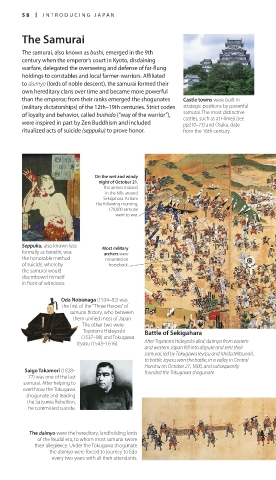
than the emperor; from their ranks emerged the shogunates Castle towns were built in
(military dictator ships) of the 12th–19th centuries. Strict codes strategic positions by powerful
of loyalty and behavior, called bushido (“way of the warrior”), samurai. The most distinctive
castles, such as at Himeji (see
were inspired in part by Zen Buddhism and included pp210–13) and Osaka, date
ritualized acts of suicide (seppuku) to prove honor. from the 16th century.
On the wet and windy
night of October 21,
the armies massed
in the hills around
Sekigahara. At 8am
the follow ing morning,
170,000 samurai
went to war.
Seppuku, also known less Most military
formally as harakiri, was archers were
the honorable method mounted on
of suicide, whereby horseback.
the samurai would
disembowel himself
in front of witnesses.
Oda Nobunaga (1534–82) was
the first of the “Three Heroes” of
samurai his tory, who between
them unified most of Japan.
The other two were
Toyotomi Hideyoshi Battle of Sekigahara
(1537–98) and Tokugawa
Ieyasu (1543–1616). After Toyotomi Hideyoshi died, daimyo from eastern
and western Japan fell into dispute and sent their
samurai, led by Tokugawa Ieyasu and Ishida Mitsunari,
to battle. Ieyasu won the battle, in a valley in Central
Honshu on October 21, 1600, and subse quently
Saigo Takamori (1828– founded the Tokugawa shogunate.
77) was one of the last
samurai. After helping to
over throw the Tokugawa
shogunate and lead ing
the Satsuma Rebellion,
he committed suicide.
The daimyo were the hereditary, landholding lords
of the feudal era, to whom most samurai swore
their allegience. Under the Tokugawa shogunate
the daimyo were forced to journey to Edo
every two years with all their attendants.
058-059_EW_Japan.indd 58 08/08/16 3:06 pm
Eyewitness Travel LAYERS PRINTED:
Feature template “UK” LAYER
(SourceReport v1.3)
Date 18th October 2012
Size 125mm x 217mm

