


Page 62 - (DK Eyewitness) Travel Guide: Japan
P. 62
60 INTRODUCING JAP AN
impregnable tem ple fortress in what is now
central Osaka. Surrounded by moats and
walls, the temple had been the power base
of the Buddhist True-Pure-Land sect.
By 1582, when he was forced to com mit
suicide by a treasonous vassal, Nobunaga
was in control of 30 of Japan’s 68 provinces.
Nobunaga’s deputy, a warrior of humble
birth named Toyotomi Hideyoshi, promptly
avenged his lord and continued the work of
unification, launching epic campaigns that
brought Shikoku (1585), Kyushu (1587), the
Kanto region (1590), and Northern Honshu
(1591) under his control. He followed up by
destroying many of the castles and forts
belonging to potential rivals, confiscating
weapons belonging to peasants, and
devising a system in which peasants held
their own small plots and paid a fixed tax
directly to the central government.
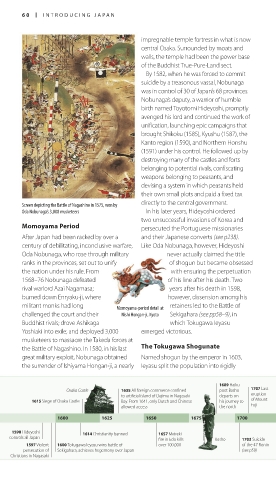
Screen depicting the Battle of Nagashino in 1575, won by
Oda Nobunaga’s 3,000 musketeers In his later years, Hideyoshi ordered
two unsuccessful invasions of Korea and
Momoyama Period persecuted the Portuguese missionaries
After Japan had been racked by over a and their Japanese converts (see p238).
century of debilitating, inconclusive warfare, Like Oda Nobunaga, however, Hideyoshi
Oda Nobunaga, who rose through military never actually claimed the title
ranks in the provin ces, set out to unify of shogun but became obsessed
the nation under his rule. From with ensuring the perpetua tion
1568–76 Nobunaga defeated of his line after his death. Two
rival warlord Azai Nagamasa; years after his death in 1598,
burned down Enryaku-ji, where however, dissension among his
militant monks had long Momoyama-period detail at re tainers led to the Battle of
challenged the court and their Nishi Hongan-ji, Kyoto Sekigahara (see pp58–9), in
Buddhist rivals; drove Ashikaga which Tokugawa Ieyasu
Yoshiaki into exile; and deployed 3,000 emerged victorious.
musketeers to massacre the Takeda forces at
the Battle of Nagashino. In 1580, in his last The Tokugawa Shogunate
great military exploit, Nobunaga obtained Named shogun by the emperor in 1603,
the surrender of Ishiyama Hongan-ji, a nearly Ieyasu split the population into rigidly
1689 Haiku
Osaka Castle 1635 All foreign commerce confined poet Basho 1707 Last
to artificial island of Dejima in Nagasaki departs on eruption
1615 Siege of Osaka Castle Bay. From 1641, only Dutch and Chinese his journey to of Mount
allowed access the north Fuji
1600 1625 1650 1675 1700
1590 Hideyoshi 1614 Christianity banned 1657 Meireki
controls all Japan
fire in Edo kills Basho 1703 Suicide
1597 Violent 1600 Tokugawa Ieyasu wins battle of over 100,000 of the 47 Ronin
persecution of Sekigahara, achieves hegemony over Japan (see p59)
Christians in Nagasaki
060-061_EW_Japan.indd 60 08/08/16 3:06 pm
Eyewitness Travel LAYERS PRINTED:
History Portrait template “UK” LAYER
(Source v1.2)
Date 20th August 2012
Size 125mm x 217mm

