


Page 63 - (DK Eyewitness) Travel Guide: Japan
P. 63
THE HIST OR Y OF JAP AN 61
defined hereditary classes. To end turf wars, James Clavell’s 1975 book Shogun). During
samurai were forbidden to own land and this time, the English, Dutch, Portuguese,
could reside only within cer tain quarters Spanish, and New World governments
of castle towns. Farmers were made overtures to the
allotted small plots, which shogunate on trade.
they were obliged to cultivate. However, the increasingly
Artisans formed the next xenophobic Tokugawa
class, merchants the bottom. regime restricted all foreign
Movement between regions was shipping to Nagasaki from 1635;
strictly regulated, and families or only Chinese and Dutch traders
whole villages could be pun ished Fireman official’s were allowed from 1641. This
for crimes by their kin or neighbors. garment in Edo heralded 200 years of isolation
The daimyo or lords who from the rest of the world.
governed regions were subject to Persecution of Chris tians intensified.
Tokugawa authority and shuffled to While Kyoto remained the official capital
different regions if their service was through the Tokugawa period, Edo eclipsed
not approved. After 1635, the daimyo it in size and was probably the largest city
and their samurai retinue were forced to in the world by around 1700. Edo also
reside every other year in the city of Edo hosted an explosion of arts such as Kabuki
(Tokyo), the new seat of the shogunate. and Bunraku theater (see pp40–41) and the
ukiyo-e works (see p89) of Utamaro, Sharaku,
Isolation and The Rise of Edo Hokusai, and Hiroshige. Patrons included
William Adams, an Englishman who the merchant class and samurai.
reached Japan on a Dutch ship in 1600, In 1853 Commodore Matthew Perry
served Ieyasu in various capacities over steamed into Edo Bay with four US
the next two decades (as portrayed in vessels to challenge Japan’s refusal to
enter into international rela tions.
Weakened by unrest from
within its own and other ranks,
the shogunate could only accede
to Perry’s demands. Samurai
from the Satsuma, Choshu,
and Tosa do mains in Kyushu,
Western Honshu, and Shikoku
became the driving force
behind a successful restoration
of imperial power and a
reorganization of the govern-
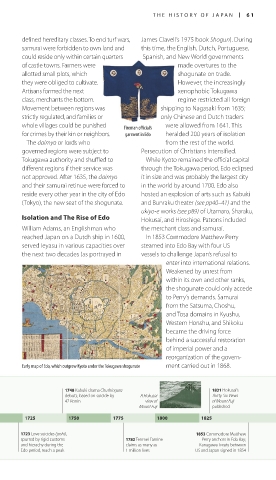
Early map of Edo, which outgrew Kyoto under the Tokugawa shogunate ment carried out in 1868.
1707 Last 1748 Kabuki drama Chushingura 1831 Hokusai’s
eruption debuts, based on suicide by A Hokusai Thirty-Six Views
of Mount 47 Ronin view of of Mount Fuji
Fuji Mount Fuji published
1700 1725 1750 1775 1800 1825
1723 Love suicides (joshi), 1853 Commodore Matthew
1703 Suicide spurred by rigid customs 1782 Tenmei Famine Perry anchors in Edo Bay;
of the 47 Ronin and hierachy during the claims as many as Kanagawa Treaty between
(see p59) Edo period, reach a peak 1 million lives US and Japan signed in 1854
060-061_EW_Japan.indd 61 08/08/16 3:06 pm

