


Page 133 - (DK Eyewitness) Travel Guide - Scotland
P. 133
SC O TLAND REGION B Y REGION 131
THE HIGHLANDS
AND ISLANDS
Most of the stock images of Scottishness – clans and tartans,
whisky and porridge, bagpipes and heather – originate in the
Highlands, and enrich the popular picture of Scotland as a whole.
But for many centuries the Gaelic-speaking, cattle-raising
Highlanders had little in common with their southern neighbours.
Clues to the non-Celtic ancestors of led by Bonnie Prince Charlie (see p157). A
the Highlanders lie scattered across the more romantic vision of the Highlands
Highlands and islands in the form of stone began to emerge in the early 19th
circles, brochs and cairns spanning over century, largely due to Sir Walter Scott’s
5,000 years. By the end of the 6th century, novels and poetry depicting the majesty
the Gaelic-speaking Celts had arrived from and grandeur of a country previously
Ireland, as had St Columba, who taught considered merely poverty-stricken and
Christianity to the monastic community barbaric. Another great popularizer was
he estab lished on the island of Iona. The later Queen Victoria, whose passion for
fusion of Christianity with Viking culture in Balmoral Castle helped establish the trend
the 8th and 9th centuries produced the for acquiring Highland sporting estates.
beautiful St Magnus Cathedral in the But behind the sentimentality lay harsh
Orkney Islands. economic realities that drove generations of
For over 1,000 years, Celtic Highland Highland farm ers to seek a new life overseas.
society was founded on a clan system, Today, over half the inhabitants of
built on family ties to create loyal groups the Highlands and islands still live in
dependent on a feudal chief. However, the communities of less than 1,000 people.
clans were systematic ally broken up by But thriving oil and tourist industries now
England after 1746, following the defeat of supplement fishing and whisky, and
the Jacobite attempt on the British crown population figures are rising.
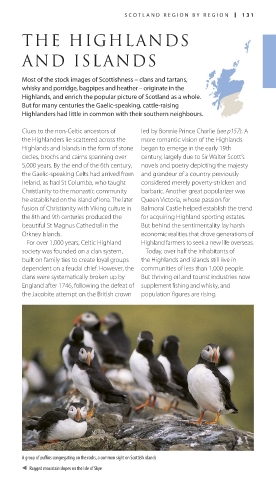
A group of puffins congregating on the rocks, a common sight on Scottish islands
Rugged mountain slopes on the Isle of Skye
130-131_EW_Scotland.indd 131 10/23/17 11:57 AM

