


Page 26 - (DK Eyewitness) Travel Guide - Scotland
P. 26
24 INTRODUCING SC O TLAND A POR TR AIT OF SC O TLAND 25
Evolution of the Scottish Castle
Later Tower-house
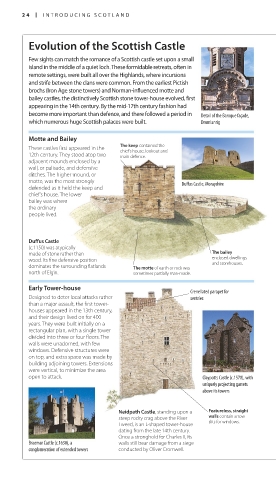
Few sights can match the romance of a Scottish castle set upon a small Though the requirements of defence were being replaced by
island in the middle of a quiet loch. These formidable retreats, often in those of comfort, the style of the early tower-house remained
remote settings, were built all over the Highlands, where incursions popular. By the 17th century wings for accom modation were
and strife between the clans were common. From the earliest Pictish being added around the original tower (often creating a
courtyard). The battlements and turrets were kept more for
brochs (Iron Age stone towers) and Norman-influenced motte and decorative than defensive reasons.
bailey castles, the distinctively Scottish stone tower-house evolved, first
appear ing in the 14th century. By the mid-17th century fashion had The priest’s room Original 15th-century Drum Castle, near Aberdeen, a
13th-century keep with a mansion house
has secret access.
become more important than defence, and there followed a period in Detail of the Baroque façade, tower-house extension from 1619
which numerous huge Scottish palaces were built. Drumlanrig
This round angle tower
contains a stairway.
Motte and Bailey
The keep contained the
These castles first appeared in the chief’s house, lookout and Sixteenth-century
12th century. They stood atop two main defence. horizontal extension
adjacent mounds enclosed by a
wall, or palisade, and defensive
ditches. The higher mound, or
motte, was the most strongly Duffus Castle, Morayshire
defended as it held the keep and
chief’s house. The lower Traquair House (see p93), by the Tweed, is the oldest
bailey was where continuously inhabited house in Scotland. The largely Decorative,
the ordinary unadorned, roughcast exterior dates from the 16th corbelled turret
people lived. century, when a series of extensions were built around Blair Castle (see p143), incorporating a
the original 15th-century tower-house. medieval tower
Classical Palace
Duffus Castle
(c.1150) was atypically By the 18th century the defensive imperative had passed
made of stone rather than The bailey and castles were built in the manner of country houses;
wood. Its fine defensive position enclosed dwellings the vertical tower-house was rejected in favour of a
and storehouses.
dominates the surrounding flatlands The motte of earth or rock was horizontal plan (though the building of imitation fortified
north of Elgin. sometimes partially man-made. buildings continued into the 19th century with the mock-
Baronial trend). Outside influences came from all over
Early Tower-house Europe, including Renaissance and Gothic revivals, with
Crenellated parapet for echoes of French châteaux.
Designed to deter local attacks rather sentries
than a major assault, the first tower- Larger windows are due to a Dunrobin Castle (c.1840), Sutherland
houses appeared in the 13th century, lesser need for defence.
and their design lived on for 400 Decorative cupola
years. They were built initially on a Balustrades replace
rectangular plan, with a single tower defensive battlements.
divided into three or four floors. The
walls were unadorned, with few
windows. Defensive structures were
on top, and extra space was made by
building adjoining towers. Extensions
were vertical, to minimize the area
open to attack. Claypotts Castle (c.1570), with
uniquely projecting garrets
above its towers
Neidpath Castle, standing upon a Featureless, straight
steep rocky crag above the River walls contain arrow
slits for windows.
Tweed, is an L-shaped tower-house
dating from the late 14th century. Drumlanrig Castle (see p94) was built in the
Once a stronghold for Charles II, its 17th century and has traditional Scots Renaissance-style colonnade
Braemar Castle (c.1630), a walls still bear damage from a siege aspects as well as Renaissance features, such
con glomeration of extended towers conducted by Oliver Cromwell. as the decorated stairway and façade. Baroque horseshoe stairway
024-025_EW_Scotland.indd 24 10/23/17 11:48 AM 024-025_EW_Scotland.indd 25 10/23/17 11:48 AM

