


Page 27 - (DK Eyewitness) Travel Guide - Scotland
P. 27
A POR TR AIT OF SC O TLAND 25
Later Tower-house
Though the requirements of defence were being replaced by
those of comfort, the style of the early tower-house remained
popular. By the 17th century wings for accom modation were
being added around the original tower (often creating a
courtyard). The battlements and turrets were kept more for
decorative than defensive reasons.
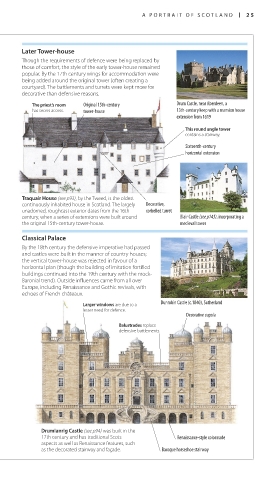
The priest’s room Original 15th-century Drum Castle, near Aberdeen, a
has secret access. tower-house 13th-century keep with a mansion house
extension from 1619
This round angle tower
contains a stairway.
Sixteenth-century
horizontal extension
Traquair House (see p93), by the Tweed, is the oldest
continuously inhabited house in Scotland. The largely Decorative,
unadorned, roughcast exterior dates from the 16th corbelled turret
century, when a series of extensions were built around Blair Castle (see p143), incorporating a
the original 15th-century tower-house. medieval tower
Classical Palace
By the 18th century the defensive imperative had passed
and castles were built in the manner of country houses;
the vertical tower-house was rejected in favour of a
horizontal plan (though the building of imitation fortified
buildings continued into the 19th century with the mock-
Baronial trend). Outside influences came from all over
Europe, including Renaissance and Gothic revivals, with
echoes of French châteaux.
Larger windows are due to a Dunrobin Castle (c.1840), Sutherland
lesser need for defence.
Decorative cupola
Balustrades replace
defensive battlements.
Drumlanrig Castle (see p94) was built in the
17th century and has traditional Scots Renaissance-style colonnade
aspects as well as Renaissance features, such
as the decorated stairway and façade. Baroque horseshoe stairway
024-025_EW_Scotland.indd 25 10/23/17 11:48 AM

