


Page 30 - (DK Eyewitness) Travel Guide - Scotland
P. 30
28 INTRODUCING SC O TLAND A POR TR AIT OF SC O TLAND 29
Great Scottish Inventions Spray nozzle
Despite its relatively small size and population, Scotland has Steam generator
produced a remarkable number of inventors over the centuries.
The late 1700s and 1800s were years of such intense creativity that
the period became known as the Scottish Enlightenment. Many
technological, medi cinal and mechanical breakthroughs were made
Antiseptic (Joseph Lister,
at this time, including the invention of the steam engine, antiseptic 1865) in the form of carbolic
and the telephone. Out of the country’s factories, universities and acid was a most important
laboratories came a breed of men who were intrepid and forward- Colour photography (1861) was breakthrough in surgery.
thinking. Their revolutionary ideas and experiments produced developed by the Scottish physicist Lister discovered that,
inventions that have shaped our modern, progressive society. James C Maxwell. The first to experi applied to wounds and
ment with threecolour photography, sprayed around the theatre,
he photographed this tartan ribbon the acid helped to prevent
Logarithm tables (1594) were Continous electric using coloured water as a filter. germs and infection.
devised by John Napier as a light (1834) was Carbolic acid reservoir
practical way of multiplying invented by James
and dividing large numbers. Bowman Lindsay using The telephone
Though easy to use, the tables galvanic cells in a (Alexander Graham
took 20 years to create. revolutionary design. The thermos flask (Sir
James Dewar, 1892) Bell, 1876) was the
was first designed as scientific break
Parallel motion operated a vacuum for storing through that
all the valves in time. lowtemperature revolutionized the
gases. The flask was way the world
later massproduced communicated,
A flywheel introducing the
The pneumatic stored energy as the thermos, for transmission of
tyre (tire) (John Piston rod so that the maintaining the sound by electricity.
Dunlop, 1887), was engine ran temperature of hot
originally patented smoothly. and cold drinks.
by RW Thomson
and then
developed by The radar receiver
Dunlop for use on (Robert WatsonWatt,
bicycles and, 1935) was in use
later, cars. long be fore World War
II, since WatsonWatt’s
team had built the first
Penicillin (Alexander Fleming, 1928) is working radar defence
a discovery that has changed the face system by 1935.
of medicine. Fleming’s brainchild was Radar is an acronym
the first antibiotic drug to treat for “radio detection
diseases, and by 1940 it was being used and ranging”.
to save the lives of wounded soldiers.
Golf clubs were
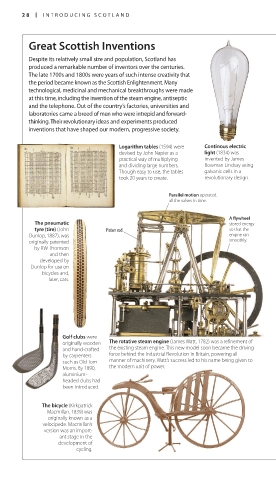
originally wooden The rotative steam engine (James Watt, 1782) was a refinement of
and hand-crafted the existing steam engine. This new model soon became the driving
by carpenters force behind the Industrial Revolution in Britain, powering all
such as Old Tom manner of machinery. Watt’s success led to his name being given to
Morris. By 1890, the modern unit of power.
aluminium-
headed clubs had
been introduced.
The bicycle (Kirkpatrick
Macmillan, 1839) was
originally known as a The first television (John Logie Baird, 1926), or
velocipede. Macmillan’s “televisor”, was black and white, and unable to Dolly the cloned sheep was created in
version was an import- produce sound and pictures together, but it was 1996 by a team of scientists at
ant stage in the nevertheless hailed as a monumental invention. In Edinburgh’s Roslin Institute. Dolly, the
development of 1928, Baird demon strated the possibilities of first successful clone of an adult animal
cycling. creating colour images. in the world, gave birth in 1998.
028-029_EW_Scotland.indd 28 10/23/17 11:56 AM 028-029_EW_Scotland.indd 29 10/23/17 11:56 AM

