


Page 26 - All About History - Issue 59-17
P. 26
the Byzantine empiRe
       History answers


                      Why did
                the Crusaders invade
                  Constantinople?

                      Eliot Issacs
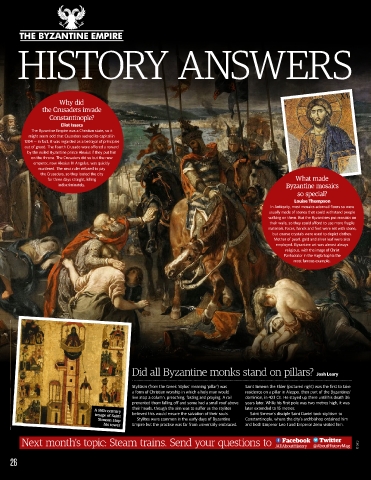
            The Byzantine Empire was a Christian state, so it
           might seem odd that Crusaders sacked its capital in
          1204 — in fact, it was regarded as a betrayal of principles
          out of greed. The Fourth Crusade were offered a reward
           by the exiled Byzantine prince Alexius if they put him
            on the throne. The Crusaders did so but the new
             emperor, now Alexius IV Angelus, was quickly
              murdered. The next ruler refused to pay
               the Crusaders, so they looted the city
                  for three days straight, killing                                                       What made
                     indiscriminately.                                                                Byzantine mosaics
                                                                                                          so special?
                                                                                                        Louise Thompson
                                                                                                In Antiquity, most mosaics adorned floors so were
                                                                                                usually made of stones that could withstand people
                                                                                               walking on them. But the Byzantines put mosaics on
                                                                                                their walls, so they could afford to use more fragile
                                                                                               materials. Faces, hands and feet were set with stone,
                                                                                                 but coarse crystals were used to depict clothes.
                                                                                                 Mother of pearl, gold and silver leaf were also
                                                                                                  employed. Byzantine art was almost always
                                                                                                     religious, with the image of Christ
                                                                                                     Pantocrator in the Hagia Sophia the
                                                                                                        most famous example.


                                               Did all Byzantine monks stand on pillars?  Josh Leary

                                               Stylitism (from the Greek ‘stylos’ meaning ‘pillar’) was   Saint Simeon the Elder (pictured right) was the first to take
                                               a form of Christian worship in which a holy man would   residence on a pillar in Aleppo, then part of the Byzantines’
                                               live atop a column, preaching, fasting and praying. A rail   dominion, in 423 CE. He stayed up there until his death 36
                                               prevented them falling off and some had a small roof above   years later. While his first pole was two metres high, it was
                                               their heads, though the aim was to suffer as the stylites   later extended to 15 metres.
                                  A 16th-century
                                  image of Saint   believed this would ensure the salvation of their souls.  Saint Simeon’s disciple Saint Daniel took stylitism to
                                   Simeon atop   Stylites were common in the early days of Byzantine   Constantinople, where the city’s archbishop ordained him
                                     his tower  Empire but the practise was far from universally embraced.   and both Emperor Leo I and Emperor Zeno visited him.
                                                                                                                 Twitter
         next month’s topic: steam trains. send your questions to                                 /AllAboutHistory  @AboutHistoryMag  © Getty
                                                                                                    Facebook

     26

