


Page 21 - All About History - Issue 59-17
P. 21
The gates were mechanised to ensure that they
                                                                                       would all open at the same time. The four horse
                                                                                       chariots were readied and brought to the gates
                                                                                       and each team usually had two chariots
                                                                                       participating in every race.

                                                                                       ready, set, go

                                                                                       A wealthy sponsor for the chariots, such as a
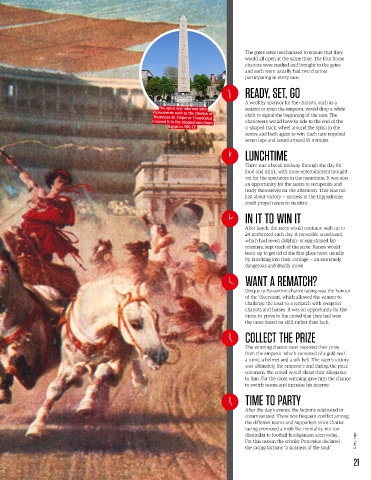
                                                         The spina was adorned with    senator or even the emperor, would drop a white
                                                       monuments such as the Obelisk of   cloth to signal the beginning of the race. The
                                                       Thutmose III. Emperor Theodosius
                                                       I moved it to the Hippodrome from   charioteers would have to ride to the end of the
                                                            Egypt in 390 CE            U-shaped track, wheel around the spina in the
                                                                                       centre and back again to win. Each race required
                                                                                       seven laps and lasted around 15 minutes.


                                                                                       lunChtime
                                                                                       There was a break midway through the day for
                                                                                       food and drink, with more entertainment brought
                                                                                       out for the spectators in the meantime. It was also
                                                                                       an opportunity for the racers to recuperate and
                                                                                       ready themselves for the afternoon. This was not
                                                                                       just about victory — success in the Hippodrome
                                                                                       could propel racers to stardom.
                                                                                       in it to win it

                                                                                       After lunch, the races would continue with up to
                                                                                       24 performed each day. A moveable scoreboard,
                                                                                       which had seven dolphin- or egg-shaped lap
                                                                                       counters, kept track of the score. Racers would
                                                                                       team up to get rid of the first-place racer, usually
                                                                                       by knocking into their carriage — an extremely
                                                                                       dangerous and deadly move.
                                                                                       want a rematCh?

                                                                                       Unique to Byzantine chariot racing was the honour
                                                                                       of the ‘diversium’, which allowed the winner to
                                                                                       challenge the loser to a rematch with swapped
                                                                                       chariots and horses. It was an opportunity for the
                                                                                       victor to prove to the crowd that they had won
                                                                                       the races based on skill, rather than luck.
                                                                                       ColleCt the prize

                                                                                       The winning chariot racer received their prize
                                                                                       from the emperor, which consisted of a gold seal,
                                                                                       a tunic, a helmet and a silk belt. The racer’s victory
                                                                                       was ultimately the emperor’s and during the prize
                                                                                       ceremony the crowd would shout their allegiance
                                                                                       to him. For the racer, winning gave him the chance
                                                                                       to switch teams and increase his income.
                                                                                       time to party

                                                                                       After the day’s events, the factions celebrated or
                                                                                       commiserated. There was frequent conflict among
                                                                                       the different teams and supporters since chariot
                                                                                       racing promoted a mob-like mentality, not too
                                                                                       dissimilar to football hooliganism seen today.
                                                                                       For this reason the scholar Procopius declared    © Getty Images
                                                                                       the racing factions “a sickness of the soul.”

                                                                                                                             21

