


Page 30 - All About History - Issue 59-17
P. 30
Norse culture


        While the most important disputes might be   the thralls, slaves who were usually foreigners
        discussed at the Allthing, crimes were normally   captured on raids.
        tried at the local and regional level at a Law-Thing,   Each year at the Thing, the free men found their
        which were smaller but more met more frequently.   voice. We say men because, although attendance
        These would cover topics such as property   was every free man’s duty, it was optional for
        disputes and marital affairs, but                  women. While it is argued that
        perhaps also those that needed   Torgny Lagmann, the   this was for the practical reason
        to be dealt with sooner, such as a   name of at least three   that someone still needed to watch
                                     law-sayers, depicted
        murder investigation.        at Uppsala            the homestead, it came with the
          In most communities, a Thing                     assumption that men should
        would be presided over by a                        handle public affairs and domestic
        chieftain or even a king. However,                 life was better suited to women.
        this was not always the case.                      Women were effectively relegated
        In Iceland there was no single                     but this made the Vikings no
        figurehead at the centre of the                    worse than that other cradle of
        rule of law and the people would                   democracy, Ancient Greece.
        elect a leader — admittedly, they                    Sitting on a panel — or a jury,
        still usually came from one of the                 as we would now call it — the
        wealthiest families on the island.                 mostly male karls would listen to
          But it was the contribution                      both sides of any dispute, with
        made by the free men, known as karls, that made   testimony from the injured party, the accused
        the Viking assemblies so much more democratic   and relevant witnesses. While the free men would
        and set the standard for the system of law we   often be swayed and influenced by the chieftain
        recognise today. Viking society had a simple   (who often had their own agenda), they would also
        structure, with the majority of wealth and power   be advised and guided by the law-sayer.
        in the hands of nobles, the jarls. Below them   In a culture that had little to no writing other
        were the karls and then at the very bottom were   than runic symbols, the laws created, decisions


   30
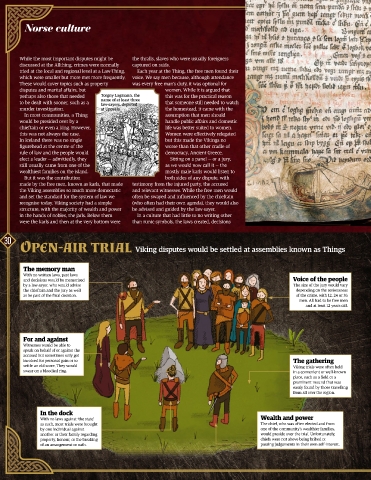
        Open-air trial Viking disputes would be settled at assemblies known as Things


         The memory man
         With no written laws, past laws
         and decisions would be memorised                                                               Voice of the people
         by a law-sayer, who would advise                                                               The size of the jury would vary
         the chieftain and the jury as well                                                              depending on the seriousness
         as be part of the final decision.                                                               of the crime, with 12, 24 or 36
                                                                                                          men. All had to be free men
                                                                                                            and at least 12 years old.


         For and against
         Witnesses would be able to
         speak on behalf of or against the
         accused but sometimes only got
         involved for personal gain or to                                                               The gathering
         settle an old score. They would                                                                Viking trials were often held
         swear on a bloodied ring.                                                                      in a convenient or well-known
                                                                                                        place, such as a field or a
                                                                                                        prominent mound that was
                                                                                                        easily found by those travelling
                                                                                                        from all over the region.


               In the dock
               With no laws against ‘the state’                                              Wealth and power
               as such, most trials were brought                                             The chief, who was often elected and from
               by one individual against                                                     one of the community’s wealthier families,
               another or their family regarding                                             would preside over the trial. Unfortunately,
               property, honour, or the breaking                                             chiefs were not above being bribed or
               of an arrangement or oath.                                                    passing judgements in their own self-interest.

