


Page 29 - All About History - Issue 59-17
P. 29
ne vivid image of Viking raiders has
              endured over the centuries: rampant,
              bloodthirsty warriors emerging from
       Otheir terrifying longships to ravage
        villages and towns, terrorising, killing without
        mercy and ransacking holy places of their precious
        and treasured possessions. To their terrified
        victims they were unruly savages, seemingly
        governed only by their thirst for battle and desire
        for gold and land.
          Yet behind the wild and uncontrollable image
        there lies a different story: men and women from
        an ordered society that had structure and a deeply
        rooted desire for fairness and justice. Punishments
        could be severely disproportionate to the crime —
        just calling someone a coward could see you have
        to fight them to the death — but the Viking legal
        system was based on a legislative assembly where
        all free men had a say and trials were carried out
        with a jury of your peers.
          We use the term Vikings broadly, but its
        wrong to think of these people as a single group
        from a single place. In the Viking Age, as now,
        Scandinavia was a complex collection of countries,
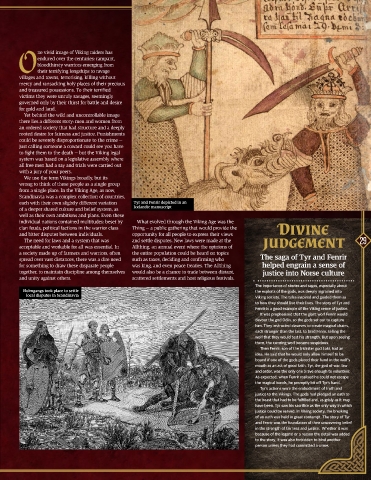
        each with their own slightly different variation   Tyr and Fenrir depicted in an
        of a deeper shared culture and belief system, as   Icelandic manuscript
        well as their own ambitions and plans. Even these
        individual nations contained multitudes: beset by   What evolved through the Viking Age was the
        clan feuds, political factions in the warrior class   Thing — a public gathering that would provide the   Divine
        and bitter disputes between individuals.   opportunity for all people to express their views
          The need for laws and a system that was   and settle disputes. New laws were made at the   judgement                 29
        acceptable and workable for all was essential. In   Allthing, an annual event where the opinions of
        a society made up of farmers and warriors, often   the entire population could be heard on topics
        spread over vast distances, there was a dire need   such as taxes, deciding and confirming who   The saga of Tyr and Fenrir
        for something to draw these disparate people   was king, and even peace treaties. The Allthing   helped engrain a sense of
        together, to maintain discipline among themselves   would also be a chance to trade between distant,   justice into Norse culture
        and unity against others.              scattered settlements and host religious festivals.
                                                                                           The importance of stories and sagas, especially about
         Holmgangs took place to settle                                                    the exploits of the gods, was deeply ingrained into
          local disputes in Scandinavia                                                    Viking society. The tales inspired and guided them as
                                                                                           to how they should live their lives. The story of Tyr and
                                                                                           Fenrir is a good example of the Viking sense of justice.
                                                                                            It was prophesised that the giant wolf Fenrir would
                                                                                           devour the god Odin, so the gods set out to capture
                                                                                           him. They instructed dwarves to create magical chains,
                                                                                           each stronger than the last, to bind Fenrir, telling the
                                                                                           wolf that they would test his strength. But upon seeing
                                                                                           them, the cunning wolf became suspicious.
                                                                                            Then Fenrir, son of the trickster god Loki, had an
                                                                                           idea. He said that he would only allow himself to be
                                                                                           bound if one of the gods placed their hand in the wolf’s
                                                                                           mouth as an act of good faith. Tyr, the god of war, law
                                                                                           and order, was the only one brave enough to volunteer.
                                                                                           As expected, when Fenrir realised he could not escape
                                                                                           the magical bonds, he promptly bit off Tyr’s hand.
                                                                                            Tyr’s actions were the embodiment of truth and
                                                                                           justice to the Vikings. The gods had pledged an oath to
                                                                                           the beast that had to be fulfilled and, as grisly as it may
                                                                                           have been, Tyr saw his sacrifice as the only way in which
                                                                                           justice could be served. In Viking society, the breaking
                                                                                           of an oath was held in great contempt. The story of Tyr
                                                                                           and Fenrir was the foundation of their unwavering belief
                                                                                           in the strength of fairness and justice.  Whether it was
                                                                                           because of the legend or a reason the detail was added
                                                                                           to the story, it was also forbidden to bind another
                                                                                           person unless they had committed a crime.

