


Page 137 - (DK) The Business Book
P. 137
MAKING MONEY WORK          135

        See also: Changing the game 92–99   ■  Organizational culture 104–09   ■   Understanding the market 234–41   ■  Focus on the
        future market 244–49   ■  Make your customers love you 264–67   ■  Maximize customer benefits 288–89


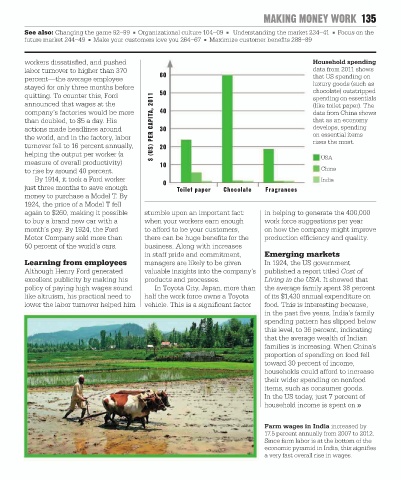
        workers dissatisfied, and pushed                                                Household spending
        labor turnover to higher than 370                                              data from 2011 shows
                                             60                                        that US spending on
        percent—the average employee
                                                                                       luxury goods (such as
        stayed for only three months before                                            chocolate) outstripped
        quitting. To counter this, Ford      50                                        spending on essentials
        announced that wages at the                                                    (like toilet paper). The
        company’s factories would be more    40                                        data from China shows
        than doubled, to $5 a day. His                                                 that as an economy
        actions made headlines around      $ (US) PER CAPITA, 2011  30                 develops, spending
        the world, and in the factory, labor                                           on essential items
                                                                                       rises the most.
        turnover fell to 16 percent annually,   20
        helping the output per worker (a                                                  USA
        measure of overall productivity)     10
        to rise by around 40 percent.                                                     China
           By 1914, it took a Ford worker                                                 India
                                              0
        just three months to save enough          Toilet paper  Chocolate  Fragrances
        money to purchase a Model T. By
        1924, the price of a Model T fell
        again to $260, making it possible    stumble upon an important fact:   in helping to generate the 400,000
        to buy a brand new car with a    when your workers earn enough    work force suggestions per year
        month’s pay. By 1924, the Ford   to afford to be your customers,   on how the company might improve
        Motor Company sold more than     there can be huge benefits for the   production efficiency and quality.
        50 percent of the world’s cars.  business. Along with increases
                                         in staff pride and commitment,   Emerging markets
        Learning from employees          managers are likely to be given   In 1924, the US government
        Although Henry Ford generated    valuable insights into the company’s  published a report titled Cost of
        excellent publicity by making his   products and processes.       Living in the USA. It showed that
        policy of paying high wages sound   In Toyota City, Japan, more than  the average family spent 38 percent
        like altruism, his practical need to   half the work force owns a Toyota   of its $1,430 annual expenditure on
        lower the labor turnover helped him  vehicle. This is a significant factor   food. This is interesting because,
                                                                          in the past five years, India’s family
                                                                          spending pattern has slipped below
                                                                          this level, to 36 percent, indicating
                                                                          that the average wealth of Indian
                                                                          families is increasing. When China’s
                                                                          proportion of spending on food fell
                                                                          toward 30 percent of income,
                                                                          households could afford to increase
                                                                          their wider spending on nonfood
                                                                          items, such as consumer goods.
                                                                          In the US today, just 7 percent of
                                                                          household income is spent on ❯❯


                                                                          Farm wages in India increased by
                                                                          17.5 percent annually from 2007 to 2012.
                                                                          Since farm labor is at the bottom of the
                                                                          economic pyramid in India, this signifies
                                                                          a very fast overall rise in wages.

