


Page 150 - (DK) The Business Book
P. 150
148 IGNORING THE HERD
        14 8

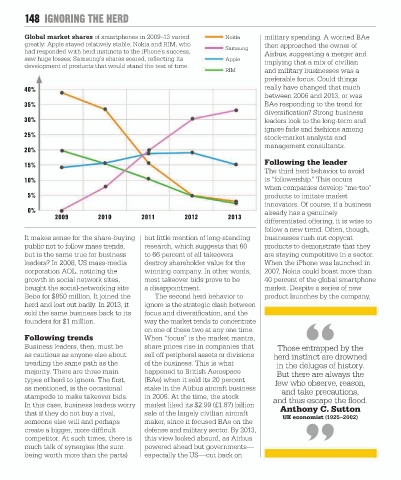
        Global market shares of smartphones in 2009–13 varied   Nokia     military spending. A worried BAe
        greatly: Apple stayed relatively stable; Nokia and RIM, who       then approached the owner of
                                                               Samsung
        had responded with herd instincts to the iPhone’s success,        Airbus, suggesting a merger and
        saw huge losses; Samsung’s shares soared, reflecting its   Apple   implying that a mix of civilian
        development of products that would stand the test of time.
                                                               RIM        and military businesses was a
                                                                          preferable focus. Could things
        40%                                                               really have changed that much
                                                                          between 2006 and 2013, or was
        35%                                                               BAe responding to the trend for
                                                                          diversification? Strong business
        30%                                                               leaders look to the long-term and
                                                                          ignore fads and fashions among
        25%                                                               stock-market analysts and
                                                                          management consultants.
        20%
                                                                          Following the leader
        15%
                                                                          The third herd behavior to avoid
        10%                                                               is “followership.” This occurs
                                                                          when companies develop “me-too”
         5%                                                               products to imitate market
                                                                          innovators. Of course, if a business
         0%                                                               already has a genuinely
                2009        2010        2011        2012        2013
                                                                          differentiated offering, it is wise to
                                                                          follow a new trend. Often, though,
        It makes sense for the share-buying   but little mention of long-standing   businesses rush out copycat
        public not to follow mass trends,   research, which suggests that 60    products to demonstrate that they
        but is the same true for business   to 66 percent of all takeovers   are staying competitive in a sector.
        leaders? In 2008, US mass-media   destroy shareholder value for the   When the iPhone was launched in
        corporation AOL, noticing the    winning company. In other words,   2007, Nokia could boast more than
        growth in social network sites,   most takeover bids prove to be    40 percent of the global smartphone
        bought the social-networking site   a disappointment.             market. Despite a series of new
        Bebo for $850 million. It joined the   The second herd behavior to   product launches by the company,
        herd and lost out badly. In 2013, it   ignore is the strategic clash between
        sold the same business back to its   focus and diversification, and the
        founders for $1 million.         way the market tends to concentrate
                                         on one of these two at any one time.
        Following trends                 When “focus” is the market mantra,
        Business leaders, then, must be    share prices rise in companies that   Those entrapped by the
        as cautious as anyone else about   sell off peripheral assets or divisions   herd instinct are drowned
        treading the same path as the    of the business. This is what       in the deluges of history.
        majority. There are three main   happened to British Aerospace       But there are always the
        types of herd to ignore. The first,    (BAe) when it sold its 20 percent   few who observe, reason,
        as mentioned, is the occasional   stake in the Airbus aircraft business   and take precautions,
        stampede to make takeover bids.    in 2006. At the time, the stock   and thus escape the flood.
        In this case, business leaders worry  market liked its $2.99 (£1.87) billion   Anthony C. Sutton
        that if they do not buy a rival,   sale of the largely civilian aircraft
                                                                               UK economist (1925–2002)
        someone else will and perhaps    maker, since it focused BAe on the
        create a bigger, more difficult   defense and military sector. By 2013,
        competitor. At such times, there is   this view looked absurd, as Airbus
        much talk of synergies (the sum   powered ahead but governments—
        being worth more than the parts)   especially the US—cut back on

