


Page 173 - (DK) The Business Book
P. 173
WORKING WITH A VISION         171

        See also: Study the competition 24–27   ■  Stand out in the market 28–31   ■  Gaining an edge 32–39   ■  Porter’s generic
        strategies 178–83   ■  Why takeovers disappoint 186–87   ■  The MABA matrix 192–93


        is struggling to win sales for its   some companies decided to
        core product, it may be tempting    “outsource”—contracting a business
        to consider diversifying, but this   activity to an outside company—
        often ends up being a distraction.  peripheral activities that they had
           During the second half of the   previously performed internally.
        20th century, there was a trend    The trend of outsourcing gathered
        for companies to acquire unrelated   momentum as companies realized
        businesses. Gillette, a leader in   they could cut their business back
        razors, bought PaperMate pens;   to the core and achieve leaner, more
        Dalgety, which made Homepride    efficient, cost-effective operations.
        Flour, acquired a pig-breeding      For example, a company that
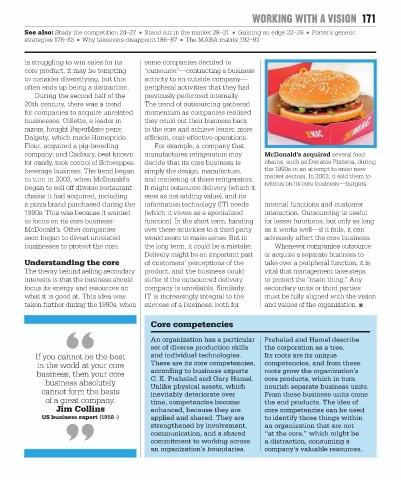
        company; and Cadbury, best known   manufactures refrigerators may   McDonald’s acquired several food
        for candy, took control of Schweppes   decide that its core business is   chains, such as Donatos Pizzeria, during
        beverage business. The trend began   simply the design, manufacture,    the 1990s in an attempt to enter new
                                                                          market sectors. In 2003, it sold them to
        to turn in 2003, when McDonald’s   and marketing of those refrigerators.
                                                                          refocus on its core business—burgers.
        began to sell off diverse restaurant   It might outsource delivery (which it
        chains it had acquired, including    sees as not adding value), and its
        a pizza brand purchased during the   information technology (IT) needs   internal functions and customer
        1990s. This was because it wanted   (which it views as a specialized   interaction. Outsourcing is useful
        to focus on its core business:   function). In the short term, handing   for lesser functions, but only as long
        McDonald’s. Other companies      over these activities to a third party   as it works well—if it fails, it can
        soon began to divest unrelated   would seem to make sense. But in   adversely affect the core business.
        businesses to protect the core.   the long term, it could be a mistake.   Whenever companies outsource
                                         Delivery might be an important part   or acquire a separate business to
        Understanding the core           of customers’ perceptions of the   take over a peripheral function, it is
        The theory behind selling secondary   product, and the business could   vital that management take steps
        interests is that the business should   suffer if the outsourced delivery   to protect the “main thing.” Any
        focus its energy and resources on   company is unreliable. Similarly,    secondary units or third parties
        what it is good at. This idea was   IT is increasingly integral to the   must be fully aligned with the vision
        taken further during the 1990s, when  success of a business, both for   and values of the organization. ■

                                           Core competencies

                                           An organization has a particular   Prahalad and Hamel describe
                                           set of diverse production skills   the corporation as a tree.
           If you cannot be the best       and individual technologies.   Its roots are its unique
           in the world at your core       These are its core competencies,   competencies, and from these
                                           according to business experts    roots grow the organization’s
           business, then your core
                                           C. K. Prahalad and Gary Hamel.   core products, which in turn
             business absolutely
                                           Unlike physical assets, which   nourish separate business units.
            cannot form the basis
                                           inevitably deteriorate over    From these business units come
              of a great company.          time, competencies become      the end products. The idea of
                Jim Collins                enhanced, because they are     core competencies can be used
             US business expert (1958–)    applied and shared. They are   to identify those things within
                                           strengthened by involvement,   an organization that are not
                                           communication, and a shared    “at the core,” which might be
                                           commitment to working across   a distraction, consuming a
                                           an organization’s boundaries.   company’s valuable resources.

