


Page 228 - (DK) The Business Book
P. 228
226 CREATING AN ETHICAL CULTURE


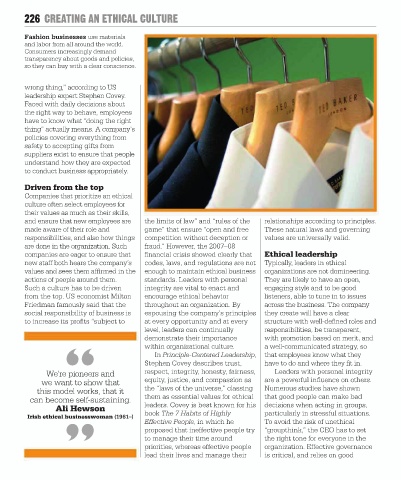
        Fashion businesses use materials
        and labor from all around the world.
        Consumers increasingly demand
        transparency about goods and policies,
        so they can buy with a clear conscience.


        wrong thing,” according to US
        leadership expert Stephen Covey.
        Faced with daily decisions about
        the right way to behave, employees
        have to know what “doing the right
        thing” actually means. A company’s
        policies covering everything from
        safety to accepting gifts from
        suppliers exist to ensure that people
        understand how they are expected
        to conduct business appropriately.

        Driven from the top
        Companies that prioritize an ethical
        culture often select employees for
        their values as much as their skills,
        and ensure that new employees are   the limits of law” and “rules of the   relationships according to principles.
        made aware of their role and     game” that ensure “open and free   These natural laws and governing
        responsibilities, and also how things   competition without deception or   values are universally valid.
        are done in the organization. Such   fraud.” However, the 2007–08
        companies are eager to ensure that   financial crisis showed clearly that   Ethical leadership
        new staff both hears the company’s   codes, laws, and regulations are not  Typically, leaders in ethical
        values and sees them affirmed in the  enough to maintain ethical business  organizations are not domineering.
        actions of people around them.   standards. Leaders with personal   They are likely to have an open,
        Such a culture has to be driven   integrity are vital to enact and   engaging style and to be good
        from the top. US economist Milton   encourage ethical behavior    listeners, able to tune in to issues
        Friedman famously said that the   throughout an organization. By   across the business. The company
        social responsibility of business is   espousing the company’s principles  they create will have a clear
        to increase its profits “subject to   at every opportunity and at every   structure with well-defined roles and
                                         level, leaders can continually   responsibilities, be transparent,
                                         demonstrate their importance     with promotion based on merit, and
                                         within organizational culture.   a well-communicated strategy, so
                                            In Principle-Centered Leadership,  that employees know what they
                                         Stephen Covey describes trust,   have to do and where they fit in.
              We’re pioneers and         respect, integrity, honesty, fairness,   Leaders with personal integrity
            we want to show that         equity, justice, and compassion as   are a powerful influence on others.
           this model works, that it     the “laws of the universe,” classing   Numerous studies have shown
         can become self-sustaining.     them as essential values for ethical   that good people can make bad
                Ali Hewson               leaders. Covey is best known for his  decisions when acting in groups,
                                         book The 7 Habits of Highly      particularly in stressful situations.
         Irish ethical businesswoman (1961–)
                                         Effective People, in which he    To avoid the risk of unethical
                                         proposed that ineffective people try   “groupthink,” the CEO has to set
                                         to manage their time around      the right tone for everyone in the
                                         priorities, whereas effective people   organization. Effective governance
                                         lead their lives and manage their   is critical, and relies on good

