


Page 223 - (DK) The Business Book
P. 223
WORKING WITH A VISION         221

        See also: Managing risk 40–41   ■  Reinventing and adapting 52–57   ■  Creativity   Thriving on chaos
        and invention 72–73   ■  Avoiding complacency 194–201
                                                                            Thriving on Chaos, written
                                                                            by US business expert Tom
                                                                            Peters, was published on
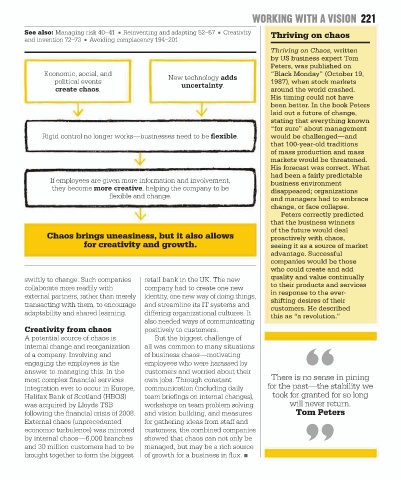
             Economic, social, and             New technology adds          “Black Monday” (October 19,
                political events                                            1987), when stock markets
                create chaos.                      uncertainty.             around the world crashed.
                                                                            His timing could not have
                                                                            been better. In the book Peters
                                                                            laid out a future of change,
                                                                            stating that everything known
                                                                            “for sure” about management
             Rigid control no longer works—businesses need to be flexible.   would be challenged—and
                                                                            that 100-year-old traditions
                                                                            of mass production and mass
                                                                            markets would be threatened.
                                                                            His forecast was correct. What
                                                                            had been a fairly predictable
               If employees are given more information and involvement,
                                                                            business environment
               they become more creative, helping the company to be         disappeared; organizations
                               flexible and change.
                                                                            and managers had to embrace
                                                                            change, or face collapse.
                                                                              Peters correctly predicted
                                                                            that the business winners
                                                                            of the future would deal
              Chaos brings uneasiness, but it also allows                   proactively with chaos,
                        for creativity and growth.                          seeing it as a source of market
                                                                            advantage. Successful
                                                                            companies would be those
                                                                            who could create and add
        swiftly to change. Such companies   retail bank in the UK. The new   quality and value continually
                                                                            to their products and services
        collaborate more readily with    company had to create one new
                                                                            in response to the ever-
        external partners, rather than merely  identity, one new way of doing things,
                                                                            shifting desires of their
        transacting with them, to encourage  and streamline its IT systems and
                                                                            customers. He described
        adaptability and shared learning.   differing organizational cultures. It
                                                                            this as “a revolution.”
                                         also needed ways of communicating
        Creativity from chaos            positively to customers.
        A potential source of chaos is      But the biggest challenge of
        internal change and reorganization   all was common to many situations
        of a company. Involving and      of business chaos—motivating
        engaging the employees is the    employees who were harassed by
        answer to managing this. In the   customers and worried about their
        most complex financial services   own jobs. Through constant         There is no sense in pining
        integration ever to occur in Europe,   communication (including daily   for the past—the stability we
        Halifax Bank of Scotland (HBOS)   team briefings on internal changes),   took for granted for so long
        was acquired by Lloyds TSB       workshops on team problem solving       will never return.
        following the financial crisis of 2008.   and vision building, and measures   Tom Peters
        External chaos (unprecedented    for gathering ideas from staff and
        economic turbulence) was mirrored   customers, the combined companies
        by internal chaos—6,000 branches   showed that chaos can not only be
        and 30 million customers had to be   managed, but may be a rich source
        brought together to form the biggest   of growth for a business in flux. ■

