


Page 257 - (DK) The Business Book
P. 257
SUCCESSFUL SELLING         255


        products with limited potential.    Nescafé coffee is Nestlé’s largest
        The coffee brand Nescafé has     brand, a cash cow valued at $17.4 billion.
        continued to perform well since its   Growing since World War II, the product
                                         generated sales of $10 billion in 2012.
        1938 launch, thanks in part to the
        company’s strategy of investing in
        and expanding the range. At      growth market, elevating food
        different times in the company’s   products for real dogs and cats into
        history it has been a cow and a star   star products.
        product. Instant coffee is now a
        reliable cow, funding expansion in   Portfolio management
        other areas. However, the company’s  Other models have evolved from the
        organic food range has suffered low   BCG. In the 1970s, General Electric
        market share in a growing market,   consulted with business advisors
        making it a question mark. Nestlé’s   McKinsey & Company to develop
        large share of the food seasonings   an alternative known as the GE–
        sector, a low-growth area, could be   McKinsey matrix. This nine-cell   competitive strength. In 1982,
        seen as a cow.                   model enables a more complex     H. C. Barksdale and C. E. Harris
           Through a series of acquisitions,  analysis of the product portfolio,   proposed two new product
        Nestlé has become the leading    and allows companies to plot     classifications to add to the original
        pet-food maker in a globally high-  market attractiveness and     BCG matrix: “warhorses” and
                                                                          “dodos.” Warhorses lead the market
                                                                          but are threatened by a negative
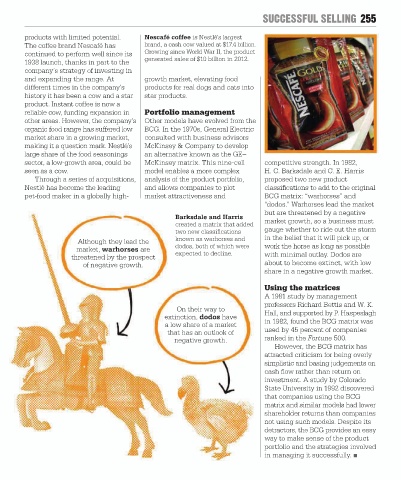
                                                 Barksdale and Harris     market growth, so a business must
                                                 created a matrix that added
                                                 two new classifications   gauge whether to ride out the storm
                      Although they lead the     known as warhorses and   in the belief that it will pick up, or
                      market, warhorses are      dodos, both of which were   work the horse as long as possible
                     threatened by the prospect    expected to decline.   with minimal outlay. Dodos are
                        of negative growth.                               about to become extinct, with low
                                                                          share in a negative growth market.

                                                                          Using the matrices
                                                                          A 1981 study by management
                                                                          professors Richard Bettis and W. K.
                                                  On their way to
                                              extinction, dodos have      Hall, and supported by P. Haspeslagh
                                              a low share of a market     in 1982, found the BCG matrix was
                                               that has an outlook of     used by 45 percent of companies
                                                 negative growth.         ranked in the Fortune 500.
                                                                             However, the BCG matrix has
                                                                          attracted criticism for being overly
                                                                          simplistic and basing judgements on
                                                                          cash flow rather than return on
                                                                          investment. A study by Colorado
                                                                          State University in 1992 discovered
                                                                          that companies using the BCG
                                                                          matrix and similar models had lower
                                                                          shareholder returns than companies
                                                                          not using such models. Despite its
                                                                          detractors, the BCG provides an easy
                                                                          way to make sense of the product
                                                                          portfolio and the strategies involved
                                                                          in managing it successfully. ■

