


Page 259 - (DK) The Business Book
P. 259
SUCCESSFUL SELLING          257

        See also: Managing risk 40–41   ■  Take the second step 43   ■  How fast to grow   Is Ansoff’s matrix
        44–45   ■  Protect the core business 170–71   ■  The MABA matrix 192–93
                                                                            still relevant?

                                                                            Igor Ansoff (1918–2002) is
                                              Increasing risk
                                                                            remembered as the father of
                                        EXISTING           NEW              modern marketing strategy.
                                       PRODUCTS         PRODUCTS            His matrix has generated many
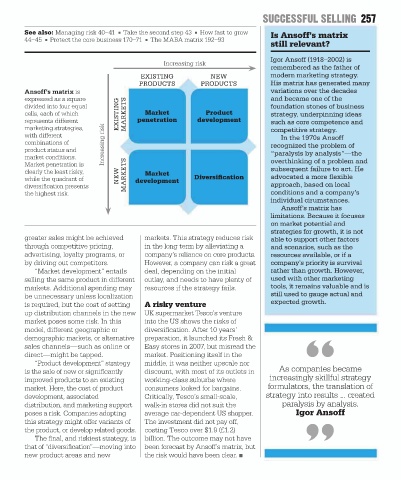
        Ansoff’s matrix is                                                  variations over the decades
        expressed as a square                                               and became one of the
        divided into four equal                                             foundation stones of business
        cells, each of which      EXISTING   MARKETS  Market   Product      strategy, underpinning ideas
        represents different           penetration     development          such as core competence and
        marketing strategies,                                               competitive strategy.
        with different                                                        In the 1970s Ansoff
        combinations of       Increasing risk                               recognized the problem of
        product status and                                                  “paralysis by analysis”—the
        market conditions.
        Market penetration is                                               overthinking of a problem and
        clearly the least risky,         Market                             subsequent failure to act. He
        while the quadrant of     NEW   MARKETS  development  Diversification  advocated a more flexible
        diversification presents                                             approach, based on local
        the highest risk.                                                   conditions and a company’s
                                                                            individual cirumstances.
                                                                              Ansoff’s matrix has
                                                                            limitations. Because it focuses
                                                                            on market potential and
                                                                            strategies for growth, it is not
        greater sales might be achieved   markets. This strategy reduces risk   able to support other factors
        through competitive pricing,     in the long term by alleviating a   and scenarios, such as the
        advertising, loyalty programs, or    company’s reliance on core products.   resources available, or if a
        by driving out competitors.      However, a company can risk a great   company’s priority is survival
           “Market development” entails   deal, depending on the initial    rather than growth. However,
        selling the same product in different   outlay, and needs to have plenty of   used with other marketing
        markets. Additional spending may   resources if the strategy fails.  tools, it remains valuable and is
        be unnecessary unless localization                                  still used to gauge actual and
        is required, but the cost of setting   A risky venture              expected growth.
        up distribution channels in the new  UK supermarket Tesco’s venture
        market poses some risk. In this   into the US shows the risks of
        model, different geographic or   diversification. After 10 years’
        demographic markets, or alternative   preparation, it launched its Fresh &
        sales channels—such as online or   Easy stores in 2007, but misread the
        direct—might be tapped.          market. Positioning itself in the
           “Product development” strategy   middle, it was neither upscale nor
        is the sale of new or significantly   discount, with most of its outlets in   As companies became
        improved products to an existing   working-class suburbs where     increasingly skillful strategy
        market. Here, the cost of product   consumers looked for bargains.   formulators, the translation of
        development, associated          Critically, Tesco’s small-scale,   strategy into results ... created
        distribution, and marketing support   walk-in stores did not suit the   paralysis by analysis.
        poses a risk. Companies adopting   average car-dependent US shopper.       Igor Ansoff
        this strategy might offer variants of   The investment did not pay off,
        the product, or develop related goods.  costing Tesco over $1.9 (£1.2)
           The final, and riskiest strategy, is  billion. The outcome may not have
        that of “diversification”—moving into  been forecast by Ansoff’s matrix, but
        new product areas and new        the risk would have been clear. ■

