


Page 53 - (DK) The Business Book
P. 53
START SMALL, THINK BIG          51


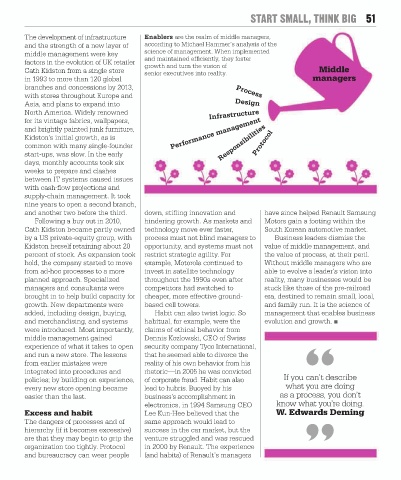
        The development of infrastructure   Enablers are the realm of middle managers,
        and the strength of a new layer of   according to Michael Hammer’s analysis of the
        middle management were key       science of management. When implemented
                                         and maintained efficiently, they foster
        factors in the evolution of UK retailer
                                         growth and turn the vision of
        Cath Kidston from a single store                                                 Middle
                                         senior executives into reality.
        in 1993 to more than 120 global                                                managers
        branches and concessions by 2013,                         Process
        with stores throughout Europe and
        Asia, and plans to expand into                            Design
        North America. Widely renowned                     Infrastructure
        for its vintage fabrics, wallpapers,
        and brightly painted junk furniture,    Performance management
                                                                       Protocol
        Kidston’s initial growth, as is
        common with many single-founder                       Responsibilities
        start-ups, was slow. In the early
        days, monthly accounts took six
        weeks to prepare and clashes
        between IT systems caused issues
        with cash-flow projections and
        supply-chain management. It took
        nine years to open a second branch,
        and another two before the third.  down, stifling innovation and   have since helped Renault Samsung
           Following a buy out in 2010,   hindering growth. As markets and   Motors gain a footing within the
        Cath Kidston became partly owned   technology move ever faster,   South Korean automotive market.
        by a US private-equity group, with   process must not blind managers to   Business leaders dismiss the
        Kidston herself retaining about 20   opportunity, and systems must not   value of middle management, and
        percent of stock. As expansion took   restrict strategic agility. For   the value of process, at their peril.
        hold, the company started to move   example, Motorola continued to   Without middle managers who are
        from ad-hoc processes to a more   invest in satellite technology   able to evolve a leader’s vision into
        planned approach. Specialized    throughout the 1990s even after   reality, many businesses would be
        managers and consultants were    competitors had switched to      stuck like those of the pre-railroad
        brought in to help build capacity for   cheaper, more effective ground-  era, destined to remain small, local,
        growth. New departments were     based cell towers.               and family run. It is the science of
        added, including design, buying,    Habit can also twist logic. So   management that enables business
        and merchandising, and systems   habitual, for example, were the   evolution and growth. ■
        were introduced. Most importantly,   claims of ethical behavior from
        middle management gained         Dennis Kozlowski, CEO of Swiss
        experience of what it takes to open   security company Tyco International,
        and run a new store. The lessons   that he seemed able to divorce the
        from earlier mistakes were       reality of his own behavior from his
        integrated into procedures and   rhetoric—in 2005 he was convicted
        policies; by building on experience,   of corporate fraud. Habit can also   If you can’t describe
        every new store opening became   lead to hubris. Buoyed by his          what you are doing
        easier than the last.            business’s accomplishment in         as a process, you don’t
                                         electronics, in 1994 Samsung CEO    know what you’re doing.
        Excess and habit                 Lee Kun-Hee believed that the       W. Edwards Deming
        The dangers of processes and of   same approach would lead to
        hierarchy (if it becomes excessive)   success in the car market, but the
        are that they may begin to grip the   venture struggled and was rescued
        organization too tightly. Protocol   in 2000 by Renault. The experience
        and bureaucracy can wear people   (and habits) of Renault’s managers

