


Page 51 - (DK) The Business Book
P. 51
START SMALL, THINK BIG          49

        See also: Beating the odds at start-up 20–21   ■  Take the second step 43   ■  Reinventing and adapting 52–57   ■  The Greiner
        curve 58–61   ■  The weightless start-up 62–63   ■  Beware the yes-men 74–75   ■  The capability maturity model 218–19


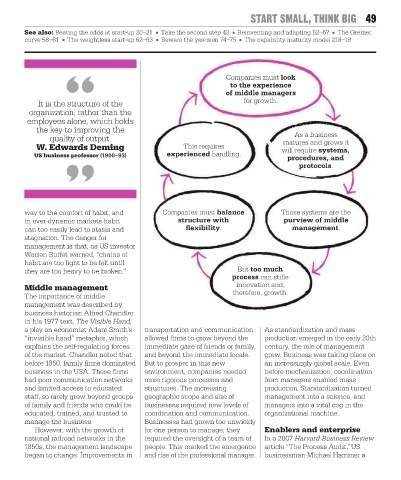
                                                               Companies must look
                                                                 to the experience
                                                               of middle managers
                                                                    for growth.
            It is the structure of the
         organization, rather than the
         employees alone, which holds
           the key to improving the
                                                                                  As a business
               quality of output.                                              matures and grows it
           W. Edwards Deming                        This requires              will require systems,
          US business professor (1900–93)      experienced handling.
                                                                                procedures, and
                                                                                   protocols.


        way to the comfort of habit, and      Companies must balance           Those systems are the
        in ever-dynamic markets habit             structure with               purview of middle
        can too easily lead to stasis and           flexibility.                   management.
        stagnation. The danger for
        management is that, as US investor
        Warren Buffet warned, “chains of
        habit are too light to be felt until
        they are too heavy to be broken.”                          But too much
                                                                 process can stifle
                                                                  innovation and,
        Middle management
                                                                 therefore, growth.
        The importance of middle
        management was described by
        business historian Alfred Chandler
        in his 1977 text, The Visible Hand,
        a play on economist Adam Smith’s   transportation and communication   As standardization and mass
        “invisible hand” metaphor, which   allowed firms to grow beyond the   production emerged in the early 20th
        explains the self-regulating forces   immediate gaze of friends or family,  century, the role of management
        of the market. Chandler noted that   and beyond the immediate locale.   grew. Business was taking place on
        before 1850, family firms dominated  But to prosper in this new    an increasingly global scale. Even
        business in the USA. These firms   environment, companies needed   before mechanization, coordination
        had poor communication networks   more rigorous processes and     from managers enabled mass
        and limited access to educated   structures. The increasing       production. Standardization turned
        staff, so rarely grew beyond groups   geographic scope and size of   management into a science, and
        of family and friends who could be   businesses required new levels of   managers into a vital cog in the
        educated, trained, and trusted to   coordination and communication.   organizational machine.
        manage the business.             Businesses had grown too unwieldy
           However, with the growth of   for one person to manage; they   Enablers and enterprise
        national railroad networks in the   required the oversight of a team of   In a 2007 Harvard Business Review
        1850s, the management landscape   people. This marked the emergence  article “The Process Audit,” US
        began to change. Improvements in   and rise of the professional manager.  businessman Michael Hammer ❯❯

