


Page 125 - (DK Eyewitness) Travel Guide - Vienna
P. 125
MUSEUM AND T OWNHALL QU AR TER 123
9 Parliament
Dr-Karl-Renner-Ring 3. Map 1 C5 & 5
A3. Tel 401100. % Volkstheater.
v D, 1, 2, 71. Open for 8 except
when parliament is in session: mid-
Sep–mid-Jul: 11am, 2pm, 3pm, 4pm
Mon–Thu; 11am, 1pm, 2pm, 3pm,
4pm Fri; 11am, noon, 1pm, 2pm, 3pm,
4pm Sat; mid-Jul–mid-Sep: 11am,
noon, 1pm, 2pm, 3pm, 4pm Mon–Sat.
7 ∑ parlament.gv.at
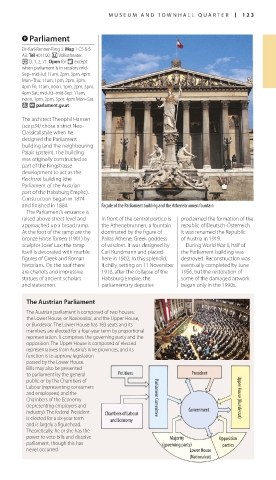
The architect Theophil Hansen
(see p34) chose a strict Neo-
Classical style when he
designed the Parliament
building (and the neighbouring
Palais Epstein). The building
was originally constructed as
part of the Ringstrasse
development to act as the
Reichsrat building (the
Parliament of the Austrian
part of the Habsburg Empire).
Construction began in 1874
and finished in 1884. Façade of the Parliament building and the Athenebrunnen fountain
The Parliament’s entrance is
raised above street level and In front of the central portico is proclaimed the formation of the
approached up a broad ramp. the Athenebrunnen, a fountain republic of Deutsch-Österreich.
At the foot of the ramp are the dominated by the figure of It was renamed the Republic
bronze Horse Tamers (1901) by Pallas Athene, Greek goddess of Austria in 1919.
sculptor Josef Lax; the ramp of wisdom. It was designed by During World War II, half of
itself is decorated with marble Carl Kundmann and placed the Parliament building was
figures of Greek and Roman here in 1902. In this splendid, destroyed. Reconst ruction was
historians. On the roof there if chilly, setting on 11 November eventually completed by June
are chariots and impressive 1918, after the collapse of the 1956, but the restoration of
statues of ancient scholars Habsburg Empire, the some of the damaged artwork
and statesmen. parliamentary deputies began only in the 1990s.
The Austrian Parliament
The Austrian parliament is composed of two houses:
the Lower House, or Nationalrat, and the Upper House,
or Bundesrat. The Lower House has 183 seats and its
members are elected for a four-year term by proportional
representation. It comprises the governing party and the
opposition. The Upper House is composed of elected
representatives from Austria’s nine provinces, and its
function is to approve legislation
passed by the Lower House.
Bills may also be presented
to parliament by the general Petitions President
public or by the Chambers of
Labour (representing consumers
and employees) and the
Chambers of the Economy Parliament Committee Upper House (Bundesrat)
(representing employers and
industry). The federal President Chambers of Labour Government
is elected for a six-year term and Economy
and is largely a figurehead.
Theoretically, he or she has the
power to veto bills and dissolve Majority Opposition
parliament, though this has (governing party) parties
never occurred. Lower House
(Nationalrat)
122-123_EW_Vienna.indd 123 03/10/17 11:00 am

