


Page 128 - (DK Eyewitness) Travel Guide - Vienna
P. 128
126 VIENNA AREA B Y AREA MUSEUM AND T OWNHALL QU AR TER 127
Exploring the Kunsthistorisches’ Picture Collection highlights include Giovanni
Bellini’s graceful Young Woman
The collection focuses on Old Masters from the 15th to at her Toilette (1515) and
the 18th centuries and largely reflects the personal tastes Tintoretto’s Susanna and the
of its Habsburg founders. Venetian and 17th-century Flemish Elders. This is considered to be
paintings are particularly well represented, and there is one of the major works of
Venetian Manner ism. Giuseppe
an excellent display of works by earlier Netherlandish and Arcimboldo’s series of allegorical
German artists. Broadly speaking, the pictures are hung portrait heads representing the
following regional schools or styles of painting, although elements and the seasons are
there is considerable overlap between the various categories. usually on show in Room 19,
together with other works
commissioned by Emperor
XIV and XX) are devoted to Rudolf II. Italian Baroque
Rubens and include large-scale paintings include works by
religious works, such as the Annibale Carracci and
Ildefonso Altarpiece (1630–32) Michelangelo Merisi da
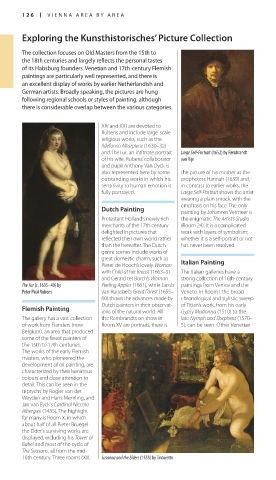
and The Fur, an intimate portrait Large Self-Portrait (1652) by Rembrandt Caravaggio, notably the huge
of his wife. Rubens’ collaborator van Rijn Madonna of the Rosary. Painted
and pupil Anthony Van Dyck is between 1606 and 1607, it
also represented here by some the picture of his mother as the depicts an intensely realistic
outstanding works in which his prophetess Hannah (1639) and, Madonna advising St Dominic
sensitivity to human emotion is in contrast to earlier works, the to distribute rosaries.
fully portrayed. Large Self-Portrait shows the artist
wearing a plain smock, with the
emphasis on his face. The only French Painting
Dutch Painting painting by Johannes Vermeer is Although the number of
Protestant Holland’s newly rich the enigmatic The Artist’s Studio French paintings on show is
merchants of the 17th century (Room 24). It is a complicated relatively small, there are some
delighted in pictures that work with layers of symbolism; minor masterpieces. The Summer (1563) by Giuseppe Arcimboldo
reflected their own world rather whether it is a self-portrait or not minutely detailed and highly
than the hereafter. The Dutch has never been resolved. original portrait of The Court destruction of the Temple of (around 1750) by Thomas
genre scenes include works of Jester Gonella (1440–45) is Solomon come true. It Gainsborough. There are also
great domestic charm, such as Italian Painting thought to be the work of Jean combines agitated movement portraits by Gainsborough,
Pieter de Hooch’s lovely Woman Fouquet. It depicts a wily old with thorough archaeological Reynolds and Lawrence.
with Child at her Breast (1663–5) The Italian galleries have a man, seemingly squeezed into research. Joseph Duplessis’ The German collection is
and Gerard ter Borch’s Woman strong collection of 16th-century the picture, believed to be a Chris topher Willibald Ritter von rich in 16th-century paintings.
The Fur (c. 1635–40) by Peeling Apples (1661), while Jacob paintings from Venice and the famous court jester of the time. Gluck at the Spinet shows the There are several Albrecht Dürer
Peter Paul Rubens van Ruisdael’s Great Forest (1655– Veneto. In Room I the broad A more formal court portrait famous composer gazing into pieces, including his Madonna
60) shows the advances made by chronological and stylistic sweep from 1569 is that of the the heavens for inspiration. with the Pear (1512). Other
Dutch painters in their observat- of Titian’s work, from his early youthful Charles IX of France by works include the Stag Hunt of
Flemish Painting
ions of the natural world. All Gypsy Madonna (1510) to the François Clouet. The Destruction Elector Friedrich the Wise (1529)
The gallery has a vast collection the Rembrandts on show in late Nymph and Shepherd (1570– of the Temple in Jerusalem, a British and German by Lucas Cranach the Elder and
of work from Flanders (now Room XV are portraits; there is 5), can be seen. Other Venetian monumental work painted by Painting seven portraits by Hans Holbein
Belgium), an area that produced Nicolas Poussin in 1638, depicts There are few British works. the Younger.
some of the finest painters of the Emperor Titus watching the Perhaps the most appealing
the 15th to 17th centuries. Old Test ament prophecy of the is the Landscape of Suffolk
The works of the early Flemish Spanish Painting
masters, who pioneered the Room 10 houses several fine
development of oil painting, are portraits of the Spanish royal
characterized by their luminous family by Diego Velázquez.
colours and close attention to The artist lived from 1599 to
detail. This can be seen in the 1660 and was the court painter
triptychs by Rogier van der to Philip IV. His works include
Weyden and Hans Memling, and three portraits of Philip IV’s
Jan van Eyck’s Cardinal Niccolo daughter, the Infanta Margarita
Albergati (1435). The highlight Teresa (in one aged three,
for many is Room X, in which another aged five and in a third
about half of all Pieter Bruegel aged eight), as well as a portrait
the Elder’s surviving works are of her sickly infant brother,
displayed, including his Tower of Philip Prosper. Other Spanish
Babel and most of the cycle of works include paintings by
The Seasons, all from the mid- Alonso Sánchez Coello and
16th century. Three rooms (XIII, Susanna and the Elders (1555) by Tintoretto Stag Hunt of Elector Friedrich the Wise (1529) by Lucas Cranach the Elder Antonio de Pereda.
126-127_EW_Vienna.indd 126 03/10/17 11:00 am 126-127_EW_Vienna.indd 127 03/10/17 11:00 am

