


Page 131 - (DK Eyewitness) Travel Guide - Vienna
P. 131
MUSEUM AND T OWNHALL QU AR TER 129
Roman emperors by artists such forms of money such as
and Roman glass. as Tilman stones used on Yap Island
Etruscan and Riemenschneider, in Micronesia.
Cypriot art are in some medie val Rooms II and III house an
rooms 1–3. Coptic, ivories, drinking extensive collection of 19th- and
Byzantine and horns and 20th-century medals. The portrait
Germanic items are Medal of Ulrich II communion vessels. medallions are often miniature
shown in the rest of Molitor (1581) The highlights of the works of art in themselves.
the rooms, where pride Italian Renaissance Particularly noteworthy are the
of place goes to the Treasure rooms are a marble bust of a unusual silver and gilt medals
of Nagyszentmiklós, a late laughing boy by Desiderio da belonging to Ulrich Molitor, the
9th-century collection Settignano, a marble relief of Abbot of Heiligenkreuz, and
of golden vessels found in Bacchus and Ariadne, and a the silver medallion which was
Romania in 1799. fine bronze and gilt figurine engraved by Bertrand Andrieu
called Venus Felix. Included in and minted to commemorate
the large German Renaissance the baptism of Napoleon’s son.
Kunstkammer Wien collection are early playing This shows the emperor as a
The curators call this “the cards and a table centrepiece proud father,
cradle of the museum”. Here, incorporating “vipers’ tongues” lifting aloft
the personal prizes of (in fact, fossilized sharks’ teeth), his baby,
Habsburg collectors Rudolf II said to ward off poison. Other the King
and Archduke Leopold William gems include Benvenuto of Rome
are housed in their “wonder Cellini’s Salt Cellar (see p124), (see p177).
rooms”. These were originally made for the
cham bers of artifacts and French
natural wonders that were king
intended to represent the François I,
sum total of human knowledge and some
of the day. In addition to statuettes by
sculpture, these princely Giambo logna.
treasuries contained
precious items of
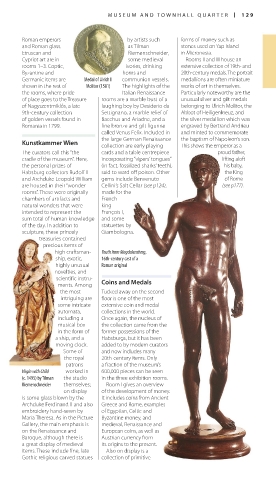
high craftsman- Youth from Magdalensberg,
ship, exotic, 16th-century cast of a
highly unusual Roman original
novelties, and
scientific instru-
ments. Among Coins and Medals
the most Tucked away on the second
intrigu ing are floor is one of the most
some intricate extensive coin and medal
auto mata, collections in the world.
including a Once again, the nucleus of
musical box the collection came from the
in the form of former possessions of the
a ship, and a Habsburgs, but it has been
moving clock. added to by modern curators
Some of and now includes many
the royal 20th-century items. Only
patrons a fraction of the museum’s
Virgin with Child worked in 600,000 pieces can be seen
(c. 1495) by Tilman the studio in the three exhibition rooms.
Riemenschneider themselves; Room I gives an overview
on display of the development of money.
is some glass blown by the It includes coins from Ancient
Archduke Ferdinand II and also Greece and Rome, examples
embroidery hand-sewn by of Egyptian, Celtic and
Maria Theresa. As in the Picture Byzantine money, and
Gallery, the main emphasis is medieval, Renaissance and
on the Renaissance and European coins, as well as
Baroque, although there is Austrian currency from
a great display of medieval its origins to the present.
items. These include fine, late Also on display is a
Gothic religious carved statues collection of primitive
128-129_EW_Vienna.indd 129 03/10/17 11:00 am

