


Page 157 - (DK Eyewitness) Travel Guide - Estonia Latvia & Lithuania
P. 157
RĪGA 155
Krišjānis Barons There are, unsurprisingly,
many paintings by Latvia’s best-
In a nation where singing is one known artist Janis Rozentāls (see
of the most important forms of p26) and his works on display
cultural expression, Krišjānis include Leaving the Cemetery
Barons (1835–1923) is perceived (1895), and Portrait of Malvīne
as a hero. Influenced by Krišjānis Vīgnere-Grinberga (1916). Other
Valdemārs (see p195) and part Latvian artists rep resented
of the group of nationalist include Jēkabs Kazaks (1895–
intellectuals known as the Young
Latvians, Barons is known for Krišjānis Barons 1920) and Romāns Suta
systematizing Latvia’s four-line folk (1896–1943), who were
songs (dainas). He did not collect them in person, but by selecting both members of the Rīga
certain songs as central and then listening to the differences Artists’ Group.
between them, he was able to include 217,996 songs in the six-
volume work he published between 1894 and 1915.
x Museum of Jews
in Latvia
350,000 four-line folk songs z Latvian National
sent by thousands of singers Museum of Art Muzejs Ebreji Latvijā
and informants. Each was Skolas iela 6. Map 2 D2. Tel 6728
written according to Barons’s Latvijas Nacionalāis mākslas musejs 3484. Open 11am–5pm Mon–Thu,
instructions on a slip of paper Kr Valdermāra 10a. Map 2 D2. Tel 6732 Sun; Jun–Aug: 11am–5pm Fri. &
the same size as cigarette- 4461. Open 10am–6pm Tue–Thu, donations. ∑ jewishmuseum.lv
paper boxes, which he used for 10am–8pm Fri, 10am–5pm Sat & Sun.
storage before the cabinet was & 8 ∑ lnmm.lv Housed inside a Jewish
built. Contrary to popular community centre, this
belief, not all the slips were The interior of this early museum is based around
rewritten by Barons. 20th-century Neo-Baroque the collec tions of Holocaust
building still has its original gilt survivors Zalman Elelson
l Orthodox and marble embellish ments. and Marğers Vestermanis. It
tells the story of the Jewish
While the collection was
Cathedral originally eclectic, in the 1920s community in Latvia, which
Pareizticīgo katedrāle and 30s the director Vilhelms begins in the 16th century
Purvītis (1872–1945), himself one with the first records of Jews
Brīvības iela 23. Map 2 D3. Tel 6721 of the country’s most famous in the country and progresses
2901. 5 8am, 6pm Mon–Sat; 6:30am, artists, decided to focus on to photo graphs of early 20th-
8:30am, 6pm Sun.
Latvian works. The first floor, century family life. Inevitably,
therefore, traces the develop- though, the focus is on the
Situated on the edge of ment of Latvian art from the mid- horrific years of the Nazi
Esplanade Park (Esplanāde), this 19th century to 1945, while the occupation. The museum does
Neo-Byzantine Russian ground floor displays 18th- and not shy away from distressing
cathedral is officially called the 19th-century Balto-Germanic images of the Holocaust, and
Cathedral of Christ’s Nativity and Russian art. The latter collec- it even includes footage of
(Kristus dzimšanas katedrāle). tion also includes many icons the massacre of Jews on
An attractive struc ture topped from the 16th to 20th centuries. Liepāja beach.
by five domes, it was built from
1876 to 1884 for the city’s
growing Russian community
and was part of a deliberate
process of Russification. It
became a Lutheran church
during the brief German
occupation of Rīga in World War I,
and once again an Orthodox
church in 1921.
As with many places of
worship, the Soviet authorities
found alternative uses for the
building during their occupa-
tion. In the 1960s they turned it
into a lecture hall and pla net-
arium. The interior decora tions
were nearly destroyed, and are
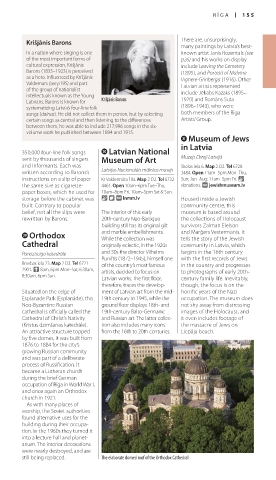
still being replaced. The elaborate domed roof of the Orthodox Cathedral
154-155_RigaCat4.indd 155 15/02/17 10:15 am

