


Page 160 - (DK Eyewitness) Travel Guide - Estonia Latvia & Lithuania
P. 160
158 LA T VIA REGION B Y REGION
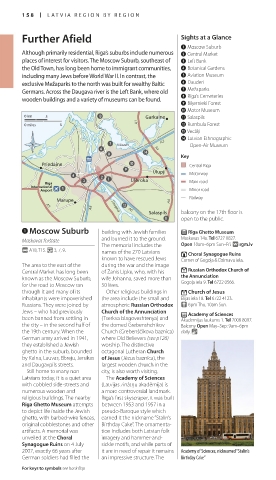
Further Afield Sights at a Glance
1 Moscow Suburb
Although primarily residential, Rīga’s suburbs include numerous 2 Central Market
places of interest for visitors. The Moscow Suburb, southeast of 3 Left Bank
the Old Town, has long been home to immigrant communities, 4 Botanical Gardens
including many Jews before World War II. In contrast, the 5 Aviation Museum
exclusive Mežaparks to the north was built for wealthy Baltic 6 Dauderi
Germans. Across the Daugava river is the Left Bank, where old 7 Mežaparks
wooden buildings and a variety of museums can be found. 8 Rīga’s Cemeteries
9 Biķernieki Forest
0 Motor Museum
0 km 5 Garkalne q Salaspils
A1 •
0 miles 5 w Rumbula Forest
e Vecāķi
r Latvian Ethnographic
A2
Kīšezers A4 Open-Air Museum
Key
Priedaįne Central Rīga
• •
Ūlupji Motorway
•
Ulbroka
Rīga Main road
International
Airport Minor road
Railway
Marupe A4
•
A8 Daugava A6
A5
Salaspils balcony on the 17th floor is
open to the public.
1 Moscow Suburb building with Jewish families E Rīga Ghetto Museum
Maskavas forštate and burned it to the ground. Maskavas 14a. Tel 6727 0827.
The memorial includes the Open 10am–6pm Sun–Fri. ∑ rgm.lv
@ A18, T15. v 3, 7, 9. names of the 270 Latvians T Choral Synagogue Ruins
known to have rescued Jews Corner of Gogoļa & Dzirnavu iela.
The area to the east of the during the war and the image
Central Market has long been of Žanis Lipke, who, with his R Russian Orthodox Church of
known as the Moscow Suburb, wife Johanna, saved more than the Annunciation
for the road to Moscow ran 50 lives. Gogoļa iela 9. Tel 6722 0566.
through it and many of its Other religious buildings in R Church of Jesus
inhabitants were impoverished the area include the small and Elijas iela 18. Tel 6722 4123.
Russians. They were joined by atmospheric Russian Orthodox 5 6pm Thu, 10am Sun.
Jews – who had previously Church of the Annunciation P Academy of Sciences
been banned from settling in (Tserkva blagoveshtenya) and Akadēmijas laukums 1. Tel 2008 8097.
the city – in the second half of the domed Grebenshchikov Balcony Open May–Sep: 9am–6pm
the 19th century. When the Church (Grebenščikova baznīca) daily. &
German army arrived in 1941, where Old Believers (see p126)
they established a Jewish worship. The dis tinctive
ghetto in the suburb, bounded octagonal Lutheran Church
by Kalna, Lauvas, Ebreju, Jersikas of Jesus (Jēzus baznīca), the
and Daugavpils streets. largest wooden church in the
Still home to many non- city, is also worth visiting.
Latvians today, it is a quiet area The Academy of Sciences
with cobbled side-streets and (Latvijas zinātņu akadēmija) is
numerous wooden and a more controversial land mark.
religious buildings. The nearby Rīga’s first skyscraper, it was built
Rīga Ghetto Museum attempts between 1953 and 1957 in a
to depict life inside the Jewish pseudo-Baroque style which
ghetto, with barbed-wire fences, earned it the nick name “Stalin’s
original cobblestones and other Birthday Cake”. The ornamenta-
artifacts. A memorial was tion includes both Latvian folk
unveiled at the Choral imagery and hammer-and-
Synagogue Ruins on 4 July sickle motifs, and while parts of
2007, exactly 66 years after it are in need of repair it remains Academy of Sciences, nicknamed “Stalin’s
German soldiers had filled the an impressive structure. The Birthday Cake”
For keys to symbols see back flap
158-159_RigaCat6.indd 158 15/02/17 10:15 am

