


Page 163 - (DK Eyewitness) Travel Guide - Estonia Latvia & Lithuania
P. 163
RĪGA 161
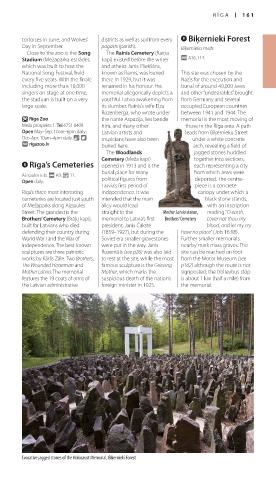
tortoises in June, and Wolves’ districts as well as soil from every 9 Biķernieki Forest
Day in September. pagasts (parish). Biķernieku mežs
Close to the zoo is the Song The Rainis Cemetery (Raiņa
Stadium (Mežaparka estrāde), kapi) existed before the writer @ A16, T14.
which was built to host the and atheist Janis Pliekšāns,
National Song Festival, held known as Rainis, was buried This site was chosen by the
every five years. With the finale there in 1929, but it was Nazis for the execution and
including more than 10,000 renamed in his honour. His burial of around 40,000 Jews
singers on stage at one time, memorial allegorically depicts a and other “undesirables” brought
the stadium is built on a very youthful Latvia awakening from from Germany and several
large scale. its slumber. Rainis’s wife Elza occupied European countries
Rozenberga, who wrote under between 1941 and 1944. The
O Rīga Zoo the name Aspazija, lies beside memorial is the most moving of
Meža prospekts 1. Tel 6751 8409. him, and many other those in the Rīga area. A path
Open May–Sep: 10am–6pm daily; Latvian artists and leads from Biķernieku Street
Oct–Apr: 10am–4pm daily. & 8 musicians have also been under a white concrete
∑ rigazoo.lv buried here. arch, revealing a field of
The Woodlands jagged stones huddled
Cemetery (Meža kapi) together into sections,
8 Rīga’s Cemeteries opened in 1913 and is the each representing a city
burial place for many from which Jews were
Aizsaules iela. @ A9. v 11.
Open daily. political figures from deported. The centre-
Latvia’s first period of piece is a concrete
Rīga’s three most interesting independence. It was canopy under which a
cemeteries are located just south intended that the main black stone stands,
of Mežaparks along Aizsaules alley would lead with an inscription
Street. The grandest is the straight to the Mother Latvia statue, reading “O earth,
Brothers’ Cemetery (Brāļu kapi), memorial to Latvia’s first Brothers’ Cemetery cover not thou my
built for Latvians who died president, Janis Čakste blood, and let my cry
defending their country during (1859–1927), but during the have no place” (Job 16:18).
World War I and the War of Soviet era smaller gravestones Further smaller memorials
Independence. The best-known were put in the way. Janis nearby mark mass graves. The
sculptures are three patriotic Rozentāls (see p26) was also laid site can be reached on foot
works by Kārlis Zāle: Two Brothers, to rest at the site, while the most from the Motor Museum (see
The Wounded Horseman and famous sculpture is the Grieving p162) although the route is not
Mother Latvia. The memorial Mother, which marks the signposted; the trolleybus stop
features the 19 coats of arms of suspicious death of the nation’s is about 1 km (half a mile) from
the Latvian administrative foreign minister in 1925. the memorial.
Evocative jagged stones of the Holocaust Memorial, Biķernieki Forest
160-161_RigaCat.indd 161 15/02/17 10:15 am

