


Page 164 - (DK Eyewitness) Travel Guide - Estonia Latvia & Lithuania
P. 164
162 LA T VIA REGION B Y REGION
several occupied count ries 1941. The victims, mostly
after Rīga’s main ghetto was women, children and the
closed. The number of people elderly from the Rīga ghetto,
who died in the camp is were shot and their bodies
disputed as the Soviet regime dumped in five mass graves.
subsequently exag gerated the Just three people are known to
figures as a propaganda tool, have survived. The location of
but it is thought that hundreds the killings came to light after
were either killed directly or the war, when two local people
died as a result of the camp’s tried to sell jewellery found in
harsh conditions. the area.
The entrance to the camp Until the late 1980s, the
is marked by a long, sloping memorials identified the dead
concrete block placed at an as Soviet citizens, although
angle to the ground, intended members of the Jewish com-
to symbolize the boundary munity illegally tended the site
Auto Union V16 racing car on display at the between life and death. The text and were eventually allowed to
Motor Museum on the block reads “Behind this add a modest stone bearing
gate the earth groans” – a line Hebrew text. The focal point of
0 Motor Museum from a poem by Eižens Vēveris, the memorial, constructed in
Rīgas motormuzejs who was a prisoner at camp. 2002, is a large menorah (seven-
Inside the block is a small branched candlestick),
S Eizenšteina 6. Tel 6702 5888. @ 5, exhibition which, like the surrounded by broken stones,
15; minibus 207, 263. Open 10am– rest of the site, has a each of which is inscribed with
6pm daily. & 8 in English or rather neglected air. the names of a murdered family.
Russian. - = Beyond this, the shape
∑ motormuzejs.lv
of the camp has been e Vecāķi
Row after row of gleaming indicated, and a metro-
cars, motorcycles and nome ticks inside a block 15 km (9 miles) NE of central Rīga. £
bicycles are housed in this of stone – its slow beat @ A24.
modern, hangar-like building. seemingly coming from
There are over 240 vehicles deep inside the earth. This stretch of coast is a popular
in total – both Latvian-made Sculpture Dominating the site is a escape from the city during
and foreign. The highlight is at Salaspils series of huge sculptures summer, although its beach is
a series taken from the erected in 1967, with rarely crowded. At the eastern
Kremlin’s collection. The titles such as The Humiliated end there is an area reserved for
former Soviet president Leonid and The Unbroken. naturists. It is worth walking west
Brezhnev, in particular, was a along the coast, towards the
motor enthusiast and one of the mouth of the Daugava river, to
exhibits is a 1966 Rolls Royce w Rumbula Forest see the remains of fortifications
Silver Shadow which he crashed Rumbulas mežs built to protect what was one of
in Moscow – a startled-looking Europe’s biggest ports. Many
waxwork sits behind the wheel. 11 km (7 miles) from central Rīga, of the bunkers date from the
There is also a heavy armoured along Maskavas iela. £ time of the Napoleonic Wars,
ZIS 115S limousine used by Stalin. but were last used during
Small panels give background At least 25,000 Jews were World War I. The fortifications
information on the vehicles and murdered in Rumbula Forest on have not been well main tained,
tell the story of the automotive 30 November and 8 December so exercise caution.
industry in Latvia. The museum
shop sells model cars.
q Salaspils
15 km (9 miles) SE of central Rīga.
£ Dārziņi. ∑ salaspils.lv
Although its history stretches
back to the 12th century,
Salaspils is notorious as the
location of a World War II
German concentration camp.
Its original inmates were
prisoners of war, but they were
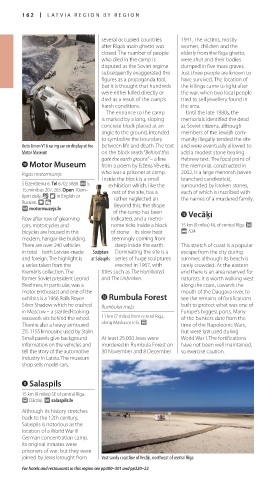
joined by Jews brought from Vast sandy coastline of Vecāķi, northeast of central Rīga
For hotels and restaurants in this region see pp300–301 and pp320–22
162-163_RigaCaTC8SS.indd 162 15/02/17 10:15 am

