


Page 85 - (DK Eyewitness) Travel Guide - Estonia Latvia & Lithuania
P. 85
T ALLINN       83


                  Peter the Great (1672–1725)
        Russia had long coveted Estonia as a much-needed outlet to Western Europe, but it
        was Peter the Great who finally achieved this. When the Treaty of Nystad ended the
        Great Northern War between Russia and Sweden in 1721, Estonia finally fell under
        Russian control. The Russian Tsar visited Tallinn 11 times during his reign and left an
        impressive legacy behind. From the magnificent Kadriorg Palace (see p80), which was
        built as a royal summer residence, to the reconstruction of the ports in Tallinn and
        Paldiski, Peter the Great’s formi dable influence is still visible. The Tsar so loved Estonia
        that he once remarked, “If Tallinn and Rogewiek [Paldiski] had been mine in 1702, I would
        not have established my residence and the capital of European Russia on the low-lying
        river Neva but here.”


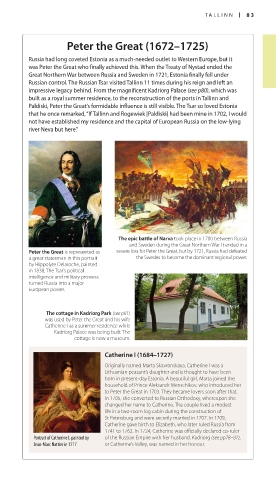
                               The epic battle of Narva took place in 1700 between Russia
                                  and Sweden during the Great Northern War. It ended in a
        Peter the Great is represented as   severe loss for Peter the Great, but by 1721, Russia had defeated
        a great statesman in this portrait   the Swedes to become the dominant regional power.
        by Hippolyte Delaroche, painted
        in 1838. The Tsar’s political
        intelligence and military prowess
        turned Russia into a major
        European power.


             The cottage in Kadriorg Park (see p81)
             was used by Peter the Great and his wife
             Catherine I as a summer residence while
               Kadriorg Palace was being built. The
                    cottage is now a museum.
                            Catherine I (1684–1727)
                            Originally named Marta Skavronskaya, Catherine I was a
                            Lithuanian peasant’s daughter and is thought to have been
                            born in present-day Estonia. A beautiful girl, Marta joined the
                            household of Prince Aleksandr Menschikov, who introduced her
                            to Peter the Great in 1703. They became lovers soon after that.
                            In 1705, she converted to Russian Orthodoxy, whereupon she
                            changed her name to Catherine. The couple lived a modest
                            life in a two-room log cabin during the construction of
                            St Petersburg and were secretly married in 1707. In 1709,
                            Catherine gave birth to Elizabeth, who later ruled Russia from
                            1741 to 1762. In 1724, Catherine was officially declared co-ruler
          Portrait of Catherine I, painted by   of the Russian Empire with her husband. Kadriorg (see pp78–81),
          Jean-Marc Nattier in 1717  or Catherine’s Valley, was named in her honour.

