


Page 87 - (DK Eyewitness) Travel Guide - Estonia Latvia & Lithuania
P. 87
T ALLINN       85


       4-km (2-mile) nature trail that         buildings from all around the
       goes through a lush range of            country. The exhibits range
       habitats, from dry meadows              from the 18th to the
       to pine forests.                        20th centuries and give a
                                               fascinating picture of how
                                               rural archi tecture developed in
       e Lasnamäe                              Estonia over the years. There
                                               are wooden wind mills,
       5 km (3 miles) NE of Tallinn.
                                               thatched barns, a village inn
       A vast Soviet-era suburb                and an 18th-century wooden
       founded on a limestone plateau          church alongside numerous
       in 1977, Lasnamäe houses                farmsteads and outbuildings.
       almost a third of the city’s              A variety of activities are
       population. The indus trial part        offered, including nature trails
       of the district is centred around       and horse and carriage rides,
       Peterburi Street. Seemingly             while regular music and
       endless rows of housing blocks          theatre productions are held
       are lined up beside Laagna   Baron von Glehn Castle in lush   here too. Annual highlights
       Street, which is a smaller road   surroundings, Nõmme  include the Midsummer’s Eve
       that passes through the                 celebra tions (see p52) and the
       so-called “Canyon”, a road   an impressive sight. The castle is   Autumn Fair.
       blasted through limestone.   only open for special events but
         The ambitious plans for the   the surrounding park, with
       making of Lasnamäe were never  some particularly eye-catching   y Aegna Island
       finished and several aborted   sta tues, can be visited any time.  Aegna saar
       building projects that abruptly         14 km (9 miles) NE of Tallinn.
       came to a halt when Estonia   + Baron von Glehn Castle  g from Pirita Harbour.
       broke away from the Soviet   Vana-Mustamäe tee 48. Tel 652 5076.
       Union, can still be seen.   Open by appointment only.  The tiny 3-sq-km (1-sq-mile)
       Although there is little of             island of Aegna is situated in
       interest, the area as a whole is a      the northeastern part of Tallinn
       strangely impressive sight and   t Estonian Open-  Bay. It has pristine sandy
       offers an intriguing glimpse of a  Air Museum    beaches and unspoiled nature,
       side of the city that most visitors   Eesti vabaõhumuuseum  which may, however, be the
       rarely see.                             target of future development.
                           Vabaõhumuuseumi tee 12. Tel 654
                           9100. @ 21, 21b. Open May–Sep:     The few traces of human
                           10am–8pm daily; Oct–Apr: 10am–   activity that can be found are
       r Nõmme                                 almost all military. There was a
                           5pm daily. & 8 call in advance.
       8 km (5 miles) S of Tallinn. £ from   7 - = ∑ evm.ee  cannon battery here during
       Tallinn. @ 14, 18, 33.                  Tsarist rule, and after being briefly
                           One of the few major sights   used by the Estonian army
       The beautiful residential district   outside the city centre, the   during the country’s first period
       of Nõmme was dev eloped as a   Estonian Open-Air Museum is   of independence, Aegna became
       suburb after a railway station   situated in the sprawling   a closed Soviet military zone.
       opened there in 1872. Soon after,  grounds of the former Rocco      The island is now governed by
       wealthy Tallinners began building  al Mare summer estate, with a   Tallinn City Council and improved
       elegant summer villas with   stunning backdrop of Kopli Bay.   ferry links have led to a steady
       spacious gardens, and by 1926,   The museum is an enormous   increase in visi tors. It is a popular
       the area had grown sufficiently   village made up of historic rural   place to pitch a tent in summer.
       to officially become a town.
       However, in 1940 the Soviets
       incorporated it into Tallinn.
          Today, Nõmme is one of the
       most attractive areas of the city,
       with its own outdoor market,
       historic centre, cafés and
       restaurants, and some fine
       museums. The Kristjan Raud
       Museum is dedicated to the
       artist who illustrated the epic
       poem Kalevipoeg, while the
       Baron von Glehn Castle, built
       by a Baltic-German landlord
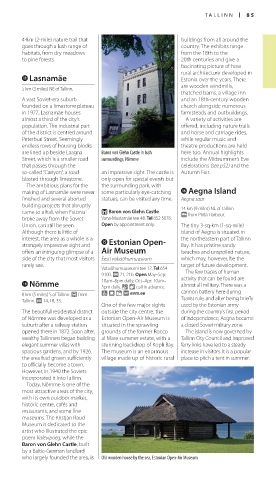
       who largely founded the area, is   Old wooden house by the sea, Estonian Open-Air Museum

