


Page 59 - All About History - Issue 26-15
P. 59
LENIN'S BLOODY REVOLUTION

                                             VYBORG
                                            DISTRICT

                                                                                         Tsar Nicholas, long the figurehead for the
                                                                                       people’s dissatisfaction – it didn’t help that his
                                                                                       household had come under the malign influence of
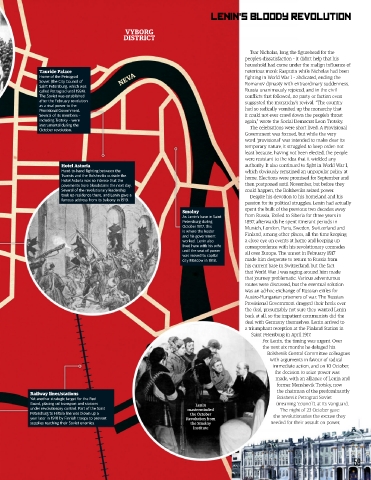
               Tauride Palace                                                          notoriousmonkRasputinwhileNicholashadbeen
               Home of the Petrograd                                                   fighting in World War I – abdicated, ending the
               Soviet (the City Council of
               Saint Petersburg, which was                                             Romanov dynasty with extraordinary suddenness.
               called Petrograd until 1924).                                           Russia unanimously rejoiced, and in the civil
               The Soviet was established                                              conflicts that followed, no party or faction even
               after the February revolution                                           suggested the monarchy’s revival. “The country
               as a rival power to the
               Provisional Government.                                                 hadsoradicallyvomitedupthemonarchythat
               Several of its members –                                                it could not ever crawl down the people’s throat
               including Trotsky – were                                                again,”wrotetheSocialDemocratLeonTrotsky.
               instrumental during the
               October revolution.                                                       The celebrations were short lived. A Provisional
                                                                                       Government was formed, but while the very
                                                                                       word ‘provisional’ was intended to make clear its
                                                                                       temporary nature, it struggled to keep order: not
                                                                                       least because, having not been elected, the people
                                                                                       were resistant to the idea that it wielded any
                       Hotel Astoria                                                   authority. It also continued to fight in World War I,
                       Hand-to-hand fighting between the                               which obviously remained an unpopular policy at
                       Tsarists and the Bolsheviks outside the
                       Hotel Astoria was so intense that the                           home. Elections were promised for September and
                       pavements bore bloodstains the next day.                        then postponed until November, but before they
                       Several of the revolutionary leadership                         could happen, the Bolsheviks seized power.
                       took up residence there, and Lenin gave a                         Despite his devotion to his homeland and his
                       famous address from its balcony in 1919.
                                                                                       passion for its political struggles, Lenin had actually
                                                                                       spent the bulk of the previous two decades away
                                                                 Smolny
                                                                 As Lenin’s base in Saint   from Russia. Exiled to Siberia for three years in
                                                                 Petersburg during     1897, afterwards he spent itinerant periods in
                                                                 October 1917, this    Munich, London, Paris, Sweden, Switzerland and
                                                                 is where the leader
                                                                 and his government    Finland, among other places, all the time keeping
                                                                 worked. Lenin also    a close eye on events at home and keeping up
                                                                 lived here with his wife   correspondence with his revolutionary comrades
                                                                 until the seat of power
                                                                 was moved to capital   all over Europe. The unrest in February 1917
                                                                 city Moscow in 1918.  made him desperate to return to Russia from
                                                                                       his current base in Switzerland, but the fact
                                                                                       that World War I was raging around him made
                                                                                       that journey problematic. Various adventurous
                                                                                       routes were discussed, but the eventual solution
                                                                                       was an ad-hoc exchange of Russian exiles for
                                                                                       Austro-Hungarian prisoners of war. The Russian
                                                                                       Provisional Government dragged their heels over
                                                                                       the deal, presumably not sure they wanted Lenin
                                                                                       back at all, so the impatient communists did the
                                                                                       deal with Germany themselves. Lenin arrived to
                                                                                       a triumphant reception at the Finland Station in
                                                                                         Saint Petersburg in April 1917.
                                                                                             For Lenin, the timing was urgent. Over
                                                                                             the next six months he deluged his
                                                                                               Bolshevik Central Committee colleagues
                                                                                                with arguments in favour of radical
                                                                                                 immediate action, and on 10 October,
                                                                                                  the decision to seize power was
                                                                                                  made, with an alliance of Lenin and
                                                                                                  former Menshevik Trotsky, now
                                                                                                  the chairman of the predominantly
            Railway lines/stations
            Yet another strategic target for the Red
            Guard, placing rail transport and stations                Lenin
            under revolutionary control. Part of the Saint         masterminded
            Petersburg to Hiitola line was blown up a               the October
            year later in 1918 by Finnish troops to prevent       Revolution from
            supplies reaching their Soviet enemies.                 the Smolny
                                                                     Institute


                                                                                                                             59

