


Page 56 - All About History - Issue 26-15
P. 56
LENIN'S BLOODY REVOLUTION


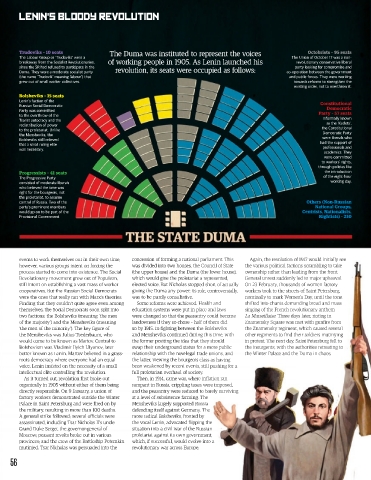
        Trudoviks – 10 seats            The Duma was instituted to represent the voices                      Octobrists – 95 seats
        The Labour Group or ‘Trudoviks’ were a                                                          The Union of October 17 was a non-
        breakaway from the Socialist Revolutionaries,   of working people in 1905. As Lenin launched his   revolutionary conservative liberal
        since the SR had refused to participate in the                                                   party looking for compromise and
        Duma. They were a moderate socialist party   revolution, its seats were occupied as follows:  co-operation between the government
        (the name ‘Trudovik’ meaning ‘labour’) that                                                    and public forces. They were working
        grew out of small worker collectives.                                                           towards reforms to strengthen the
                                                                                                        existing order, not to overthrow it.
        Bolsheviks – 15 seats
        Lenin’s faction of the
        Russian Social Democratic                                                                                 Constitutional
        Party was committed                                                                                         Democratic
        to the overthrow of the                                                                                  Party – 57 seats
        Tsarist autocracy and the                                                                                 Informally known
                                                                                                                    as the ‘Kadets’,
        redistribution of power
        to the proletariat. Unlike                                                                                the Constitutional
                                                                                                                  Democratic Party
        the Mensheviks, the
        Bolsheviks still believed                                                                                 were liberals who
                                                                                                                  had the support of
        that a small ruling elite
        was necessary.                                                                                            professionals and
                                                                                                                   academics. They
                                                                                                                   were committed
                                                                                                                  to workers’ rights,
                                                                                                                 through policies like
        Progressists – 41 seats                                                                                    the introduction
        The Progressive Party                                                                                      of the eight-hour
                                                                                                                     working day.
        consisted of moderate liberals
        who believed the time was
        right for the bourgeois, not
        the proletariat, to assume
        control of Russia. Two of the                                                                        Others (Non-Russian
        party’s prominent members                                                                               National Groups,
        would go on to be part of the                                                                      Centrists, Nationalists,
        Provisional Government.                                                                                  Rightists) - 230


        events to work themselves out in their own time,   concession of forming a nationa
        however, various groups intent on forcing the   was divided into two houses, th
        process started to come into existence. The Social   (the upper house) and the Duma
        Revolutionary movement grew out of Populism,   which would give the proletariat
        still intent on establishing a vast mass of worker   elected voice. But Nicholas stopp
        cooperatives. But the Russian Social Democrats   giving the Duma any power: its
        were the ones that really ran with Marx’s theories.   was to be purely consultative.
        Finding that they couldn’t quite agree even among   Some reforms were achieved.
        themselves, the Social Democrats soon split into   education systems were put in p
        two factions: the Bolsheviks (meaning ‘the men   were changed so that the peasa
        of the majority’) and the Mensheviks (meaning   landowners if they so chose – ha
        ‘the men of the minority’). The key figure of   so by 1915. In-fighting between t
        the Mensheviks was Julius Tsederbaum, who   and Mensheviks continued duri
        would come to be known as Martov. Central to   the former positing the idea tha
        Bolshevism was Vladimir Ilyich Ulyanov, later   swap their underground status f
        better known as Lenin. Martov believed in a grass-  relationship with the now-legal t
        roots democracy where everyone had an equal   the latter, viewing the bourgeois
        voice. Lenin insisted on the necessity of a small   been weakened by recent event
        intellectual elite controlling the revolution.   full proletarian overhaul of socie
          As it turned out, revolution first broke out   Then, in 1914, came war, wher
        organically in 1905 without either of them being   rampant in Russia, crippling tax
        directly responsible. On 9 January, a union of   and the peasantry were reduced
        factory workers demonstrated outside the Winter   at a level of subsistence farming
        Palace in Saint Petersburg and were fired on by   Mensheviks largely supported R
        the military, resulting in more than 100 deaths.   defending itself against German
        A general strike followed; several officials were   more radical Bolsheviks, fronted
        assassinated, including Tsar Nicholas II’s uncle   the vocal Lenin, advocated flipp
        Grand Duke Sergei, the governor-general of   situation into a civil war of the R
        Moscow; peasant revolts broke out in various   proletariat against its own gover
        provinces; and the crew of the Battleship Potemkin   which, if successful, would evolv
        mutinied. Tsar Nicholas was persuaded into the   revolutionary war across Europe
     56

