


Page 47 - Aviation News (February 2020)
P. 47
weather operations. The Soviets flew
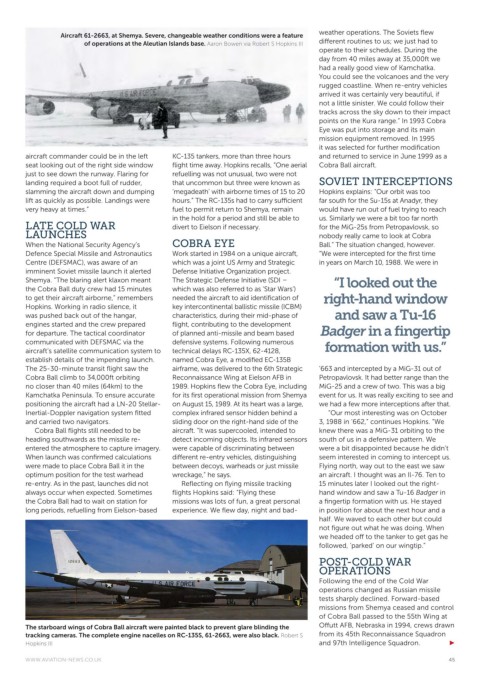
                    Aircraft 61-2663, at Shemya. Severe, changeable weather conditions were a feature
                          of operations at the Aleutian Islands base. Aaron Bowen via Robert S Hopkins III  different routines to us; we just had to
                                                                                    operate to their schedules. During the
                                                                                    day from 40 miles away at 35,000ft we
                                                                                    had a really good view of Kamchatka.
                                                                                    You could see the volcanoes and the very
                                                                                    rugged coastline. When re-entry vehicles
                                                                                    arrived it was certainly very beautiful, if
                                                                                    not a little sinister. We could follow their
                                                                                    tracks across the sky down to their impact
                                                                                    points on the Kura range.” In 1993 Cobra
                                                                                    Eye was put into storage and its main
                                                                                    mission equipment removed. In 1995
                                                                                    it was selected for further modification
           aircraft commander could be in the left   KC-135 tankers, more than three hours   and returned to service in June 1999 as a
           seat looking out of the right side window   flight time away. Hopkins recalls, “One aerial   Cobra Ball aircraft.
           just to see down the runway. Flaring for   refuelling was not unusual, two were not
           landing required a boot full of rudder,   that uncommon but three were known as   SOVIET INTERCEPTIONS
           slamming the aircraft down and dumping   ‘megadeath’ with airborne times of 15 to 20   Hopkins explains: “Our orbit was too
           lift as quickly as possible. Landings were   hours.” The RC-135s had to carry sufficient   far south for the Su-15s at Anadyr, they
           very heavy at times.”                fuel to permit return to Shemya, remain   would have run out of fuel trying to reach
                                                in the hold for a period and still be able to   us. Similarly we were a bit too far north
           LATE COLD WAR                        divert to Eielson if necessary.     for the MiG-25s from Petropavlovsk, so
           LAUNCHES                                                                 nobody really came to look at Cobra
           When the National Security Agency’s   COBRA EYE                          Ball.” The situation changed, however.
           Defence Special Missile and Astronautics   Work started in 1984 on a unique aircraft,   “We were intercepted for the first time
           Centre (DEFSMAC), was aware of an    which was a joint US Army and Strategic   in years on March 10, 1988. We were in
           imminent Soviet missile launch it alerted   Defense Initiative Organization project.
           Shemya. “The blaring alert klaxon meant   The Strategic Defense Initiative (SDI –   “I looked out the
           the Cobra Ball duty crew had 15 minutes   which was also referred to as ‘Star Wars’)
           to get their aircraft airborne,” remembers   needed the aircraft to aid identification of   right-hand window
           Hopkins. Working in radio silence, it   key intercontinental ballistic missile (ICBM)
           was pushed back out of the hangar,   characteristics, during their mid-phase of   and saw a Tu-16
           engines started and the crew prepared   flight, contributing to the development
           for departure. The tactical coordinator   of planned anti-missile and beam based   Badger in a fingertip
           communicated with DEFSMAC via the    defensive systems. Following numerous   formation with us.”
           aircraft’s satellite communication system to   technical delays RC-135X, 62-4128,
           establish details of the impending launch.   named Cobra Eye, a modified EC-135B
           The 25-30-minute transit flight saw the   airframe, was delivered to the 6th Strategic   ’663 and intercepted by a MiG-31 out of
           Cobra Ball climb to 34,000ft orbiting   Reconnaissance Wing at Eielson AFB in   Petropavlovsk. It had better range than the
           no closer than 40 miles (64km) to the   1989. Hopkins flew the Cobra Eye, including   MiG-25 and a crew of two. This was a big
           Kamchatka Peninsula. To ensure accurate   for its first operational mission from Shemya   event for us. It was really exciting to see and
           positioning the aircraft had a LN-20 Stellar-  on August 15, 1989. At its heart was a large,   we had a few more interceptions after that.
           Inertial-Doppler navigation system fitted   complex infrared sensor hidden behind a   “Our most interesting was on October
           and carried two navigators.          sliding door on the right-hand side of the   3, 1988 in ’662,” continues Hopkins. “We
              Cobra Ball flights still needed to be   aircraft. “It was supercooled, intended to   knew there was a MiG-31 orbiting to the
           heading southwards as the missile re-  detect incoming objects. Its infrared sensors   south of us in a defensive pattern. We
           entered the atmosphere to capture imagery.   were capable of discriminating between   were a bit disappointed because he didn’t
           When launch was confirmed calculations   different re-entry vehicles, distinguishing   seem interested in coming to intercept us.
           were made to place Cobra Ball it in the   between decoys, warheads or just missile   Flying north, way out to the east we saw
           optimum position for the test warhead   wreckage,” he says.              an aircraft. I thought was an Il-76. Ten to
           re-entry. As in the past, launches did not   Reflecting on flying missile tracking   15 minutes later I looked out the right-
           always occur when expected. Sometimes   flights Hopkins said: “Flying these   hand window and saw a Tu-16 Badger in
           the Cobra Ball had to wait on station for   missions was lots of fun, a great personal   a fingertip formation with us. He stayed
           long periods, refuelling from Eielson-based   experience. We flew day, night and bad-  in position for about the next hour and a
                                                                                    half. We waved to each other but could
                                                                                    not figure out what he was doing. When
                                                                                    we headed off to the tanker to get gas he
                                                                                    followed, ‘parked’ on our wingtip.”
                                                                                    POST-COLD WAR
                                                                                    OPERATIONS
                                                                                    Following the end of the Cold War
                                                                                    operations changed as Russian missile
                                                                                    tests sharply declined. Forward-based
                                                                                    missions from Shemya ceased and control
                                                                                    of Cobra Ball passed to the 55th Wing at
           The starboard wings of Cobra Ball aircraft were painted black to prevent glare blinding the   Offutt AFB, Nebraska in 1994, crews drawn
           tracking cameras. The complete engine nacelles on RC-135S, 61-2663, were also black. Robert S   from its 45th Reconnaissance Squadron
           Hopkins III                                                              and 97th Intelligence Squadron.

           WWW.AVIATION-NEWS.CO.UK                                                                                   45


       42-47_cobraDC.mfDC.mfDC.mfDC.mfDC.indd   45                                                               10/01/2020   14:32

