


Page 46 - Aviation News (February 2020)
P. 46
During a night mission on                                                     the crew to go to oxygen. River
           October 4, 1968 for the first time                                               Amber disappeared over the sea
           a Soviet multiple warhead missile                                                with all 19 crew. No trace of the
           was tracked. When the Soviets                                                    aircraft or crew has ever been
           switched to day launches, new                                                    found and the cause of the loss
           camera lenses were introduced.                                                   officially remains undetermined.
           Occasionally the finish on the                                                     A replacement, C-135B 61-
           Rivet Ball’s upper wing had                                                      2663, was quickly identified.
           reflected low-angle sunlight,                                                    Its interim fit used some of the
           blinding the cameras. When the                                                   equipment salvaged from Rivet
           aircraft next returned from Big                                                  Ball, with a single camera window
           Safari modification the starboard                                                and dipole aerials. It began flying
           wing and inner engine sides were                                                 from Eielson in early 1970.
           painted black to reduce the glare.                                                 EC-135N 61-2664, then
           It was the beginning of a tradition                                              with a bulbous nose and
           that continues today, although no                                                equipped as an Apollo Range
           longer necessary.                                                                Instrumentation Aircraft, was
              On return from a successful                                                   selected for conversion. Both
           mission the camera’s calibration                                                 were designated RC-135S and
           was rechecked and exposed film                                                   their equipment was regularly
           and tape recordings removed.                                                     upgraded during periodic Big
           They were sent under armed                                                       Safari depot maintenance
           guard to Wright-Patterson AFB,                                                   periods. The number of fuselage
           Ohio for exploitation. The aircraft                                              windows decreased as fewer
           was refuelled, towed back into                                                   cameras were carried, while the
           the hangar, reloaded with film and                                               forward fuselage aerials remained
           prepared to fly. It would be ready                                               with slight positional changes.
           to go again within eight hours.                                                  Importantly both aircraft were
              Just after midnight on January                                                fitted with TF33-P-5 engines,
           13, 1969, Rivet Ball pilot Maj                                                   which had thrust reversers to
           John Anchor made a normal                                                        shorten landing runs on Shemya.
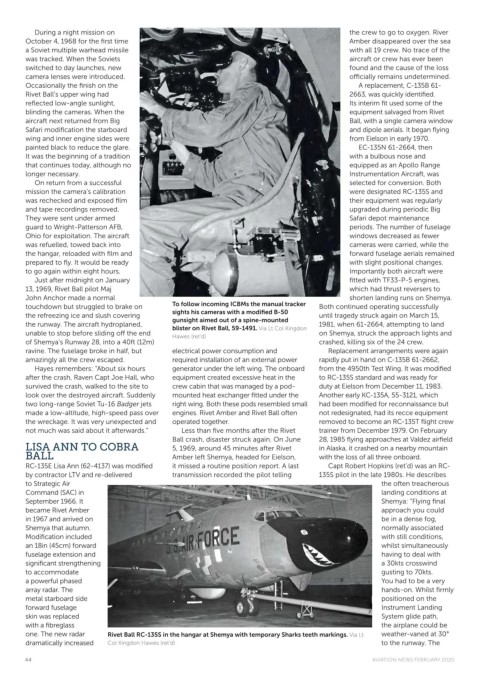
           touchdown but struggled to brake on   To follow incoming ICBMs the manual tracker   Both continued operating successfully
           the refreezing ice and slush covering   sights his cameras with a modified B-50   until tragedy struck again on March 15,
           the runway. The aircraft hydroplaned,   gunsight aimed out of a spine-mounted   1981, when 61-2664, attempting to land
                                                blister on Rivet Ball, 59-1491. Via Lt Col Kingdon
           unable to stop before sliding off the end   Hawes (ret’d)                on Shemya, struck the approach lights and
           of Shemya’s Runway 28, into a 40ft (12m)                                 crashed, killing six of the 24 crew.
           ravine. The fuselage broke in half, but   electrical power consumption and   Replacement arrangements were again
           amazingly all the crew escaped.      required installation of an external power   rapidly put in hand on C-135B 61-2662,
              Hayes remembers: “About six hours   generator under the left wing. The onboard   from the 4950th Test Wing. It was modified
           after the crash, Raven Capt Joe Hall, who   equipment created excessive heat in the   to RC-135S standard and was ready for
           survived the crash, walked to the site to   crew cabin that was managed by a pod-  duty at Eielson from December 11, 1983.
           look over the destroyed aircraft. Suddenly   mounted heat exchanger fitted under the   Another early KC-135A, 55-3121, which
           two long-range Soviet Tu-16 Badger jets   right wing. Both these pods resembled small   had been modified for reconnaissance but
           made a low-altitude, high-speed pass over   engines. Rivet Amber and Rivet Ball often   not redesignated, had its recce equipment
           the wreckage. It was very unexpected and   operated together.            removed to become an RC-135T flight crew
           not much was said about it afterwards.”  Less than five months after the Rivet   trainer from December 1979. On February
                                                Ball crash, disaster struck again. On June   28, 1985 flying approaches at Valdez airfield
           LISA ANN TO COBRA                    5, 1969, around 45 minutes after Rivet   in Alaska, it crashed on a nearby mountain
           BALL                                 Amber left Shemya, headed for Eielson,   with the loss of all three onboard.
           RC-135E Lisa Ann (62-4137) was modified   it missed a routine position report. A last   Capt Robert Hopkins (ret’d) was an RC-
           by contractor LTV and re-delivered   transmission recorded the pilot telling   135S pilot in the late 1980s. He describes
           to Strategic Air                                                                         the often treacherous
           Command (SAC) in                                                                         landing conditions at
           September 1966. It                                                                       Shemya: “Flying final
           became Rivet Amber                                                                       approach you could
           in 1967 and arrived on                                                                   be in a dense fog,
           Shemya that autumn.                                                                      normally associated
           Modification included                                                                    with still conditions,
           an 18in (45cm) forward                                                                   whilst simultaneously
           fuselage extension and                                                                   having to deal with
           significant strengthening                                                                a 30kts crosswind
           to accommodate                                                                           gusting to 70kts.
           a powerful phased                                                                        You had to be a very
           array radar. The                                                                         hands-on. Whilst firmly
           metal starboard side                                                                     positioned on the
           forward fuselage                                                                         Instrument Landing
           skin was replaced                                                                        System glide path,
           with a fibreglass                                                                        the airplane could be
           one. The new radar   Rivet Ball RC-135S in the hangar at Shemya with temporary Sharks teeth markings. Via Lt   weather-vaned at 30°
           dramatically increased   Col Kingdon Hawes (ret’d)                                       to the runway. The

           44                                                                                     AVIATION NEWS FEBRUARY 2020


       42-47_cobraDC.mfDC.mfDC.mfDC.mfDC.indd   44                                                               10/01/2020   14:31

