


Page 48 - Aviation News (February 2020)
P. 48
OTHER USAF RC-135 VARIANTS

             RC-135U Combat Sent
             Two of the original three RC-135U Combat Sent aircraft, first converted in
             1970, continue to fly and collect detailed electronic intelligence (ELINT)
             data related to radar and SAM emitter systems which can be immediately
             transmitted or recorded for later exploitation. Their most distinctive
             external feature is their chin fairing, making them the heaviest variant in the
             RC-135 fleet. Combat Sent crews comprise a minimum of ten electronic
             warfare officers (EWOs) or ‘Ravens’, two airborne systems engineers, plus
             six or more other specialists and four flight crew.


                                                                  One of the ten RC-135W Rivet Joint aircraft that carry the same
                                                                  equipment as the seven RC-135Vs. USAF
                                                                  They are crewed by a team of approximately 12 linguists/analysts and three
                                                                  Ravens, plus maintenance technicians and four flight crew.
                                                                  Most recent modifications include a small ‘hump’ in front of the tail. This is
             The RC-135U Combat Sent can be easily distinguished from other    understood to be connected with the Family of Advanced Beyond-Line-
             RC-135 variants by its different nose configuration. This example,    of-Sight Terminals (FAB-T) which permit secure Presidential and National
             64-14847/OF, also sports a shark’s mouth. AirTeamImages.com/Ian Tate  Voice Conferencing (PNVC) and data transmission over the US satellite
                                                                  communications system.
             RC-135V/W Rivet Joint                                The entire RC-135 fleet is continually being upgraded as individual aircraft pass
             Both the RC-135V and ’W Rivet Joint reconnaissance aircraft generally   through Periodic Depot Maintenance, so airframe equipment fits are rarely
             carry the same equipment. The difference in designation between the   identical. That situation can be further complicated by short-term additions of
             two variants comes from their origins. The seven RC-135Vs started life as   specialised items to meet urgent requirements for specific operations.
             RC-135C Big Team aircraft and one is a converted RC-135U. The RC-135Ws   Three aircraft are used to train RC-135 pilots and navigators. One is
             are modified C-135Bs and RC-135M Rivet Card airframes. Both the V and   designated a TC-135S for Cobra Ball crew training and two are TC-135Ws
             W operate as advanced stand-off signals intelligence (SIGINT) platforms   for the Rivet Joint fleet. While they don’t carry mission equipment they are
             able to collect huge volumes of data, voice and electronic transmissions.   fitted with the same navigational systems as the operational aircraft.

           The aircraft participated in operations   range optical and infrared surveillance   a ‘routine mission’ 150 miles (240km) off
           Enduring Freedom and Iraqi Freedom,   devices. Also, there is the Multiple   the North Korean coast the RC-135S was
           although no details of the missions have   Tracking Optical System (MTOS) uses   shadowed for 22 minutes.
           been disclosed.                      electro-optical and infrared radiometric   Justin George in The Week magazine
              Cobra Ball airframes have been regularly   sensors which assists later materials   reported that on March 29, 2019 RC-
           modernised, managed by contractor    analysis of tracked missiles.       135S 62-4128 departed Diego Garcia,
           L3 Communications. Today they have     Designated operating locations away   with two KC-135R tankers in support.
           a more uniform external appearance,   from Offutt AFB include: Eielson AFB, RAF   It monitored an Indian anti-satellite
           with the large cheek bulges, similar to   Mildenhall, Souda Bay on Crete, Kadena   missile test over the Bay of Bengal. The
           the RC-135V/W Rivet Joint aircraft with   AB, Japan, Al Udeid in the UAE and Diego   interceptor missile was launched from
           which they now share significantly greater   Garcia in the Indian Ocean.   Abdul Kalam Island on India’s east coast
           commonality. The Cobra Ball aircraft were   The USAF remains very tight-lipped about   against a Microsat-R, a 1,631lb (740kg)
           also re-engined with CFM56 turbofans   Cobra Ball activity. On a few occasions   military satellite it had launched two
           along with the rest of the RC-135 fleet   Cobra Ball missions have come to public   months earlier. Less clear was if the
           more than 15 years ago.              attention. On March 2, 2003 two North   RC-135S collected data from the anti-
              An operational crew is comprised   Korean Mikoyan MiG-29s and two MiG-23s   satellite missile’s launch phase, or if it
           of 11 people: pilot, co-pilot, navigator,   intercepted 61-2663, operating from Kadena   was observing and tracking target debris
           three electronic warfare officers, two   AB, over the Sea of Japan. Described as   as it re-entered the atmosphere.
           airborne system                                                                              Significant recent
           engineers, two                                                                            increases in Russian
           operators and a                                                                           missile tests from
           tactical coordinator.                                                                     the Barents Sea and
           The operators and                                                                         Plesetsk in northwest
           Ravens continue to                                                                        Russia plus launch
           be seated down the                                                                        exercises in the Baltic
           right-hand side of                                                                        have seen Cobra
           the aircraft. These                                                                       Ball deployments
           can be augmented                                                                          to Europe stepped
           by additional crew                                                                        up. More Chinese
           members when                                                                              and North Korean
           required. Today                                                                           missile tests have
           sensors look out                                                                          similarly resulted in
           of both sides of                                                                          a growing number
           the aircraft. They                                                                        of deployments to
           include the Textron-                                                                      Japan. North Korean
           built Medium Wave                                                                         launches have
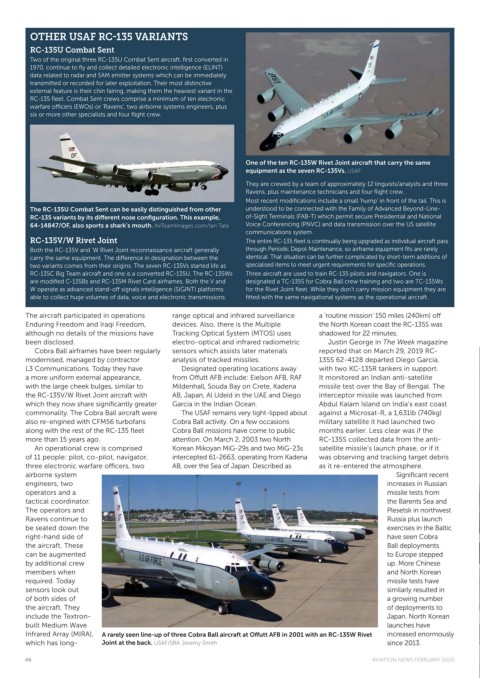
           Infrared Array (MIRA),   A rarely seen line-up of three Cobra Ball aircraft at Offutt AFB in 2001 with an RC-135W Rivet   increased enormously
           which has long-    Joint at the back. USAF/SRA Jeremy Smith                               since 2013.

           46                                                                                     AVIATION NEWS FEBRUARY 2020


       42-47_cobraDC.mfDC.mfDC.mfDC.mfDC.indd   46                                                               10/01/2020   14:32

