


Page 45 - Aviation News (February 2020)
P. 45
dominates the island, which is also home   be on station within 45 minutes of being
                                                to the Cobra Dane fi xed radar site that   alerted. “We orbited to the north of the
                                                looks towards Kamchatka.            expected re-entry area, keeping a good
                                                                                    distance from the Kamchatka coast. We
                                                FIRST PLATFORMS                     were never intercepted by Soviet fi ghters
                                                In October 1960 General Dynamics    during my time,” Hawes remembers.
                                                completed modifi cations of KC-135A     As signal monitor Hawes controlled
                                                59-1491 through its secretive Big Safari   the Ballistic Streak Camera (BSC) and
                                                programme. Operated by Air Force    determined which cameras were auto-
                                                Systems Command and codenamed Nancy   controlled or assigned to the MT. He
                                                Rae, it was redesignated a JKC-135A. The   assisted the tactical co-ordinator in
                                                aircraft arrived at Shemya on December   deciding when to start the aircraft’s
                                                31, 1961 with its four fl ight and ten mission   southerly run. “We would tell the pilot to
                                                crew. Retired USAF Lt Col Kingdon Hawes,   start down the ‘data track’ as we called it,
                                                was a signal monitor on board that aircraft   ideally to be in the middle of that run to
                                                and describes it: “Down the starboard side   photograph the missile as it re-entered.”
                                                were ten windows behind which specialist   It was not a precise calculation. “Our best
                                                cameras sat including 16mm, 35mm and   indication came from the nose-mounted
                                                70mm movie cameras and UV and IR    antenna, operated by Raven 3, who tracked
                                                equipment to photograph the warheads.   the Mode-S beacon on the missile’s test
                                                The pedestal-mounted cameras could   warhead.” Raven 4 captured transmissions
           Main photo: RC-135S, 61-4128, is pictured   be aimed automatically, or by the Manual   from the Soviet range equipment as it
           in its current Cobra Ball confi guration.   Tracker (MT) [person] using a modifi ed   tracked re-entry. Onboard USAF Security
           Dan Stijovich                        gunsight from a B-50. The MT sat on   Service operators listened for any Soviet air
                                                a raised chair looking out of an upper   defence responses.
                   uring the Cold War the Kura   fuselage observation blister.” In addition   “When the MT saw the incoming
                   warhead test range on the huge,   to cameras, spectrometers, radiometers   missile, usually as it began to break up
                   largely desolate Kamchatka   and photometers attempted to detect   [separate], he shouted, ‘Gaslight, Gaslight,
          DPeninsula in the Soviet Far East     the missiles’ material composition and   Gaslight.’ The tactical co-ordinator
           was the standard aim point for hundreds of   measure electromagnetic radiation.  fl icked the master switch turning on all
           missile tests. It is an area of approximately   Three large dipole antennae were   the cameras. The gyro-stabilised BSC
           38 sq miles (98.4km ) with the nearest   externally mounted on the right-hand   was about four feet wide, fi ve feet high
           settlement being Klyuchi. Construction   side of the aircraft with another on the   and weighed several hundred pounds. It
           started in 1955 of six monitoring posts to   left. These collected missile telemetry   pointed out of the number one window,
           record missile warhead re-entry. The fi rst   with an AN/ALA-6 direction-fi nding   closest to the nose. An infrared sensor
           use of the range for this was on August 21,   antenna on the underside. Soviet   pointed out of a central window. The
           1957 when an R-7 missile launched from   transmissions were monitored from four   manual tracker aimed his sight towards
           Tyuratam (today’s Baikonur), 3,940 miles   ‘Raven’ operator’s positions.   the small bright ‘star’ that came through
           (6,339km) away in Kazakhstan, broke up   The crews were divided into two teams   the missile debris. This was the test
           prematurely just prior to re-entry.  that rotated out of their home base at   warhead and when his crosshairs were
              To determine Soviet missile capabilities   Eielson AFB to Shemya every other week.   matched with the infrared auto-tracker he
           US intelligence operations concentrated   “We worked on good quality intelligence,”   heard a tone. He fl icked another switch
           on the inhospitable Aleutian Islands,   recalls Hawes. “Occasionally launches   that slaved everything to the auto tracker
           close to the Russian Far East coastline.   happened that we knew nothing about, but   until impact. The whole thing was over in
           One island, Shemya, was ideally located   that was unusual. Most weeks we fl ew one   about 30 seconds.”
           as a base for US reconnaissance aircraft.   or two missions; it was rare not to have at   Regular name changes were a feature
           Still incredibly remote, it is less than six   least one. On about 90% of our fl ights we   of 59-1491’s career. In 1963 it was
           sq miles (15½km ) in size and regularly   had missile intercepts.”       redesignated an RC-135S, codenamed
           a  ected by severe, rapidly changeable   For the fi rst few years most test   Nancy Rae, then Wanda Belle and from
           weather. The 10,000ft (3,048m) runway   launches were at night. Nancy Rae could   March 1967 Rivet Ball.


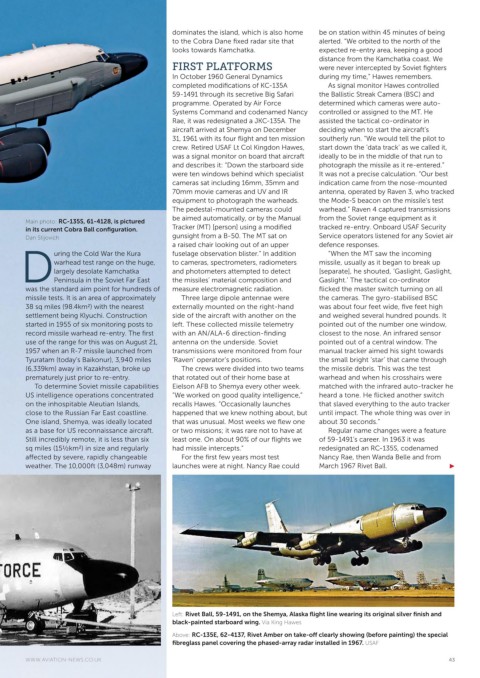
                                                Left: Rivet Ball, 59-1491, on the Shemya, Alaska fl ight line wearing its original silver fi nish and
                                                black-painted starboard wing. Via King Hawes
                                                Above: RC-135E, 62-4137, Rivet Amber on take-o   clearly showing (before painting) the special
                                                fi breglass panel covering the phased-array radar installed in 1967. USAF

           WWW.AVIATION NEWS.CO.UK                                                                                   43


       42-47_cobraDC.mfDC.mfDC.mfDC.mfDC.indd   43                                                               10/01/2020   14:31

