


Page 16 - All About History - Issue 08-14
P. 16
Crime


                       Crime across history


        TRIAL OF SOCRATES                                                                                 Spanish

        GREECE 399 BCE                                                                                    Inquisition
        One of the most famous criminal trials in                                                         SPAIN 1478
        history, the trial and subsequent execution                                                       One of the biggest crimes
        of Socrates echoes through the ages. Wrongly                                                      in Medieval Europe was
        accused of impious acts, including ‘failing to   Socrates is considered one                       that of heresy, specifically
                                           of history’s greatest minds
                                                                                                          heresy against the Catholic
        acknowledge the gods that the city [of Athens]
                                                                                                          Christian god, resulting
        acknowledges’ and ‘introducing new deities’, through                                              in the formation of the
        his philosophical musings and teachings, Socrates                                                 Spanish Inquisition. As
        was put before an Athenian jury and, after refusing to                                            such, throughout Spain and
                                                                                                          Europe, Jews, protestants
        defend himself against the spurious charges brought
                                                                                                          and anyone perceived to
        against him, was sentenced to death.                                                              be practicing witchcraft,
          His followers then encouraged him to flee from the                                              sodomy, bigamy or
        city only for the philosopher to refuse in accordance                                             blasphemy were tortured
        with his philosophy of obedience to law. He then                                                  and then, once condemned –
                                                                                                          usually by forced confession
        proceeded to take the law into his own hands and
                                                                                                          – executed. Burning and
        carried out his own execution, drinking a poisonous                                               hanging were the two most
        cup of hemlock. Today, Socrates’s death is held up                                                common punishments for
                                Greek scholar Zaleucus creates
        as an example of the unreliability of democratic rule   The Spanish Inquisition                   the crime of heresy.
        and human-created laws.                   was ruthlessly efficient
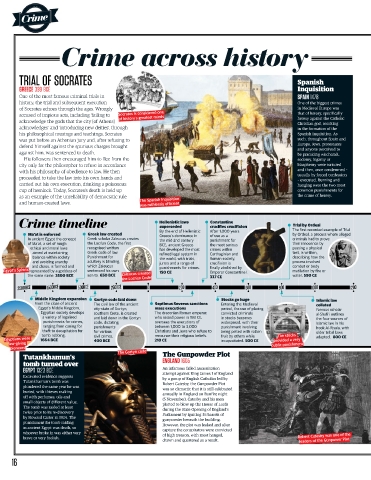
        Crime timeline                                 l Hellenistic laws   l  Constantine            l  Trial by Ordeal
                                                         superseded
                                                                           crucifies crucifixion
                                                                                                        by Ordeal, a process where alleged
         l  Ma’at is enforced  l  Greek law created       By the end of Hellenistic   After 1,000 years   The first recorded example of Trial
                                                         Greece’s dominance in
                                                                           of use as a
           In ancient Egypt the concept                  the mid-2nd century   punishment for           criminals had to prove
           of Ma’at, a set of rough   the Locrian Code, the first   BCE, ancient Greece   the most serious   their innocence by
            ethical and moral laws   recognised written   has developed the most   crimes within        passing a physical
             aimed at maintaining   Greek code of law.   refined legal system in   Carthaginian and     test, is written,
             balance within society   Punishment for     the world, with trials,   Roman society,       describing how the
             and avoiding anarchy   adultery is blinding,   jurors and a range of   crucifixion is      process involved
            and chaos, is formed and   which Zaleucus    punishments for crimes.   finally abolished by   combat or body
  Egypt’s Sphinx  represented by a goddess of   sentenced his own   150 CE  Emperor Constantine I.      mutilation by fire or
           the same name. 2500 BCE  son to. 650 BCE  Zaleucus created      337 CE                       water. 590 CE
                                            the Locrian Code
       2500 BCE   1500BCE   500BCE      250BCE       0          200         400        600         800        1000          1200
            l  Middle Kingdom expansion l  Gortyn code laid down             l  Stocks go huge                l  Islamic law
             From the close of ancient   The civil law of the ancient   l  Septimus Severus sanctions   Entering the Medieval   collated
               Egypt’s Middle Kingdom,   city-state of Gortyn,   mass executions  period, the use of placing    Famous scholar
               Egyptian society develops   southern Crete, is created   The draconian Roman emperor,   convicted criminals   al-Shafi’i outlines
                a variety of legalised   and laid down in the Gortyn   who seized power in 193 CE,   in stocks becomes   the four sources of
                punishments for crimes,   code, dictating   oversees the executions of   widespread, with their   Islamic law in his
                ranging from caning for   punishments   between 1,000 to 3,000   punishment involving           book Al-Risala, with
                theft to decapitation for   for various   Christians and Jews who refuse to   being pelted with rotten   older tribal laws
                tomb robbing.     civil crimes.        renounce their religious beliefs.  fruit by others while   The stocks   adapted.  800 CE
  Egyptians were    1664 BCE      400 BCE              210 CE                  incapacitated. 500 CE  provided a very
    law-giving                                                                                  public punishment
     pioneers
                                          The Gortyn code  The Gunpowder Plot
         Tutankhamun’s
         tomb turned over                                 ENGLAND 1605
         EGYPT 1323 BCE                                   An infamous failed assassination
                                                          attempt against King James I of England
         Excavated evidence suggests
                                                          by a group of English Catholics led by
         Tutankhamun’s tomb was
                                                          Robert Catesby, the Gunpowder Plot
         plundered the same year he was
                                                          was so climactic that it is still celebrated
         buried, with thieves making
                                                          annually in England on Bonfire night
         off with perfumes, oils and
                                                          (5 November). Catesby and his men
         small objects of different value.
                                                          plotted to blow up the House of Lords
         The tomb was raided at least
                                                          during the State Opening of England’s
         twice prior to its re-discovery
                                                          Parliament by igniting 36 barrels of
         by Howard Carter in 1924. The
                                                          gunpowder beneath the building.
         punishment for tomb raiding
                                                          However, the plot was leaked and after
         in ancient Egypt was death, so
                                                          capture the conspirators were convicted
         whoever broke in was either very
                                                          of high treason, with most hanged,              Robert Catesby was one of the
         brave or very foolish.
                                                          drawn and quartered as a result.                leaders of the Gunpower Plot
     16

