


Page 52 - All About History - Issue 08-14
P. 52
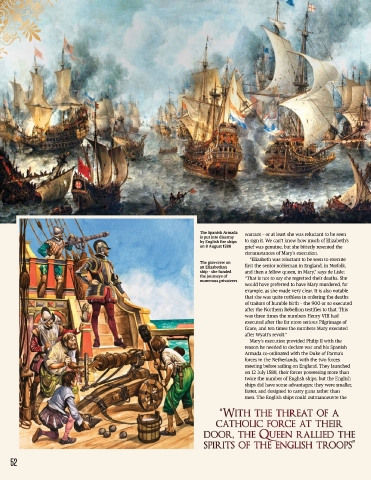
The Spanish Armada
                                                                       is put into disarray
                                                                                       to sign it. We can’t know how much of Elizabeth’s
                                                                       by English fire ships   warrant – or at least she was reluctant to be seen
                                                                       on 8 August 1588  grief was genuine, but she bitterly resented the
                                                                                       circumstances of Mary’s execution.
                                                                                         “Elizabeth was reluctant to be seen to execute
                                                                       The gun-crew on
                                                                       an Elizabethan   first the senior nobleman in England, in Norfolk,
                                                                       ship – she funded   and then a fellow queen, in Mary,” says de Lisle:
                                                                       the journeys of   “That is not to say she regretted their deaths. She
                                                                       numerous privateers
                                                                                       would have preferred to have Mary murdered, for
                                                                                       example, as she made very clear. It is also notable
                                                                                       that she was quite ruthless in ordering the deaths
                                                                                       of traitors of humble birth – the 900 or so executed
                                                                                       after the Northern Rebellion testifies to that. This
                                                                                       was three times the numbers Henry VIII had
                                                                                       executed after the far more serious Pilgrimage of
                                                                                       Grace, and ten times the numbers Mary executed
                                                                                       after Wyatt’s revolt.”
                                                                                         Mary’s execution provided Philip II with the
                                                                                       reason he needed to declare war and his Spanish
                                                                                       Armada co-ordinated with the Duke of Parma’s
                                                                                       forces in the Netherlands, with the two forces
                                                                                       meeting before sailing on England. They launched
                                                                                       on 12 July 1588, their forces possessing more than
                                                                                       twice the number of English ships, but the English
                                                                                       ships did have some advantages; they were smaller,
                                                                                       faster, and designed to carry guns rather than
                                                                                       men. The English ships could outmanoeuvre the


     52

