


Page 54 - All About History - Issue 08-14
P. 54
a sign of how much she leaned on her old guard   dramatic head when he half-drew his sword on   Tyrone on the battlefield, he met him in secret and
        that she continued to place her trust in William   her in a fit of pique.      returned to England having made a treaty without
        Cecil, even though he was almost entirely deaf   The arts and literature may have been   the queen’s authority.
        and increasingly ill. It was only when he died   flourishing, but those who subscribe to this being   When Essex thought Cecil was plotting against
        in 1598 that Elizabeth finally agreed to appoint   a golden age in England’s history often forget   him, he rushed to plead his case. Assuming he
        Robert Cecil to his father’s old post. When it   that even after the defeat of the Spanish Armada,   was still the queen’s favourite, he burst into her
        became known that the Spanish were attempting   other uprisings, such as the 1598 Irish rebellion,   bedchamber while she was preparing for the
        to rebuild their fleet, Essex led a fleet on Cadiz   occurred. The country had long been a problem   day. He had seen Elizabeth without her make-up
        and decimated their forces in port. The success   for Tudor England, which had attempted to   and regal dressing; not as a queen but as an old
        gave Essex fame, something Elizabeth was taken   impose English values and had seen the Irish as   woman. She could not afford to be seen like this.
        aback by. She tried to curb him, aware that her   tenants on English territory. Now, with a Spanish-  The queen dismissed him before summoning
        standing among the people was her greatest asset,   backed uprising, Elizabeth needed to take decisive   him later to confront him with his failures and
        but Essex continued to promote his own celebrity.   action. She sent her army at the start of 1599, led   strip him of power. Rather than accepting his fate,
        She became more and more frustrated with his   by Essex, who was looking to prove himself once   Essex attempted rebellion. He assumed Londoners
        outrageous behaviour at court, which came to a   more. He was a disaster. Rather than confronting   would back the popular war hero, but Elizabeth
                                                                                       proclaimed him a traitor and sent her troops to
                                                                                       meet him. The rebellion was a failure and Essex
                                                                                       was executed as a traitor.
                                                                                         Although the later years of Elizabeth’s reign were
          The early years of Elizabeth’s reign were extremely   Rebellions             far from golden, she could still rally her people
          unstable. The Catholics regarded her as a heretical                          when needed. The war in Ireland was expensive
          bastard without a just claim to the throne, and she had to   against         and unsuccessful, while overcrowding and failed
          prove to her people that she was capable of ruling alone.

          Conspiracies at home and abroad plotted to remove her   Elizabeth            harvests caused agitation. When Parliament
          from the throne, and when Mary, Queen of Scots took   When Elizabeth ascended to the throne she   publicly condemned her for granting monopolies
          refuge in England, her Catholic enemies finally had someone   immediately faced the threat of rebellion   to her favourite courtiers, which had led to price-
          to rally around. 1569 saw her face the first real uprising   from the Catholic nobility, who resented   fixing, Elizabeth was forced to address them in
          with the Northern Rebellion. The Earls of Westmorland and   the fact that she was turning away from   1601. She agreed to put a stop to the monopolies
          Northumberland rallied the rebel aristocracy around them,   the changes made by her sister Mary. The   and she reaffirmed her love for England. She
          but they were not prepared for the force of her reprisal.  first great uprising came in 1569, when the
            In her later years she saw rebellion rear its head again   northern noblemen took advantage of the   won over Parliament, there was a good harvest,
          as Essex overstepped his bounds. With famine and   return of Mary, Queen of Scots to England,   and a truce was reached in Ireland and Spain.
          overcrowded of cities, Elizabeth’s position became unstable   and attempted to overthrow her. The Duke   “Elizabeth, old and ill, did lose some of her former
          once again. “Imagine if Elizabeth had died in October 1562   of Norfolk, unhappy with being sidelined by   grip, but never entirely,” states de Lisle. “She had
          when she had smallpox,” asks de Lisle: “Elizabeth had   the Earl of Dudley, entertained a marriage plot   followed Mary I’s example in wooing the common
          been on the throne almost four years: only a year short of   with Mary, while the northern Earls mounted   people from the beginning of her reign, and they
          her sister’s reign. If she died, as many feared she would,   rebellion. It was summarily crushed and
          how would her reign have been remembered? Elizabeth’s   hundreds were executed.  continued to support her.”
          religious settlement was not viewed as settled by anyone   The Earl of Essex, Elizabeth’s great   Having seen off another uprising, the 50-year-old
          save the Queen. One of her own bishops called it ‘a leaden   favourite, attempted a rebellion in 1601 after   monarch’s health was failing and after an all-too-
          mediocrity’. In military matters, while Mary I’s loss of Calais   he was stripped of his powers in an attempt   rare period of good health, Elizabeth grew sickly.
          is still remembered, Elizabeth’s failed efforts to recover   to gain power. In line with his apparently   She was desperately frustrated by Cecil’s growing
          Calais by taking Le Havre and using it as a bargaining tool   oversized ego, he overestimated his personal
          are completely forgotten. The campaign had ended that   popularity, the people’s dissatisfaction with
          August 1562, with the huge loss of 2,000 men.”  their monarch and his Queen’s capacity for
                                                    forgiveness for one of her former favourites.
          Verdict                                   When Elizabeth was confronted with open
          Elizabeth’s reign featured numerous rebellions and   defiance she rarely hesitated to crush it. She
          uprisings, but this was not unusual for a Tudor monarch,   understood when to be brutal and when to
          and given the religious uncertainty in the country at the   charm. With the rebellions against her she was
          time, she handled the uprisings quickly and decisively.  unforgiving and generally unsparing.


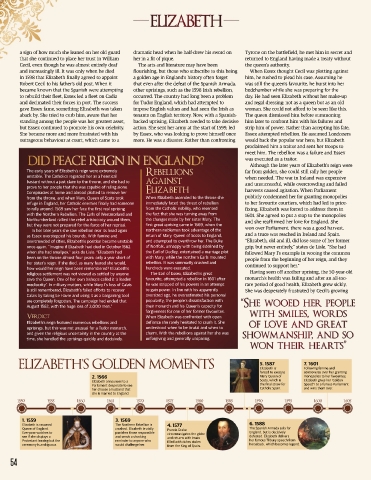
       ELIZABETH’S GOLDEN MOMENTS                                                           5. 1587         7.  1601
                                                                                                            Following famine and
                                                                                            Elizabeth is
                                                                                            forced to execute   controversy over her granting
                                 2. 1566                                                    Mary Queen of   monopolies to her favourites,
                                 Elizabeth announces to a                                   Scots, which is    Elizabeth gives her ‘Golden
                                 Parliament desperate to see                                the final straw for   Speech’ to a furious Parliament
                                 her choose a husband that                                  Catholic Spain.  and wins them over.
                                 she is married to England.
       1550       1555      1560       1565      1570      1575       1580      1585       1590      1595      1600       1605


         1. 1559                          3. 1569
         Elizabeth is crowned             The Northern Rebellion is   4. 1577            6. 1588
         Queen of England.                crushed. Elizabeth brutally   Francis Drake    The Spanish Armada sails for
         Everyone watches to              punishes those responsible   circumnavigates the globe   England, but is decisively
         see if she displays a            and sends a shocking   and returns with boats   defeated. Elizabeth delivers
         Protestant leaning but the       reminder to anyone who   filled with riches stolen   her famous Tilbury speech from
         ceremony is ambiguous.           would challenge her.  from the King of Spain.  horseback, which becomes legend.
     54

