


Page 57 - All About History - Issue 08-14
P. 57
Hitler’s astronauts
n the Twenties and Thirties a young German
rocket scientist by the name of Wernher von
Braun had dreams of exploring the stars. He
was not alone; hundreds of engineers were
Istarting to identify themselves as ‘rocket
scientists’, taking theoretical proposals of manned
space exploration and turning them into full-
fledged concepts. Before the outbreak of World
War II, Hitler learned of their research and, more
specifically, the terrible devastation their rockets
could wreak on Germany’s enemies. Before long,
many of these rocket scientists were enlisted
in the construction of so-called unfathomable
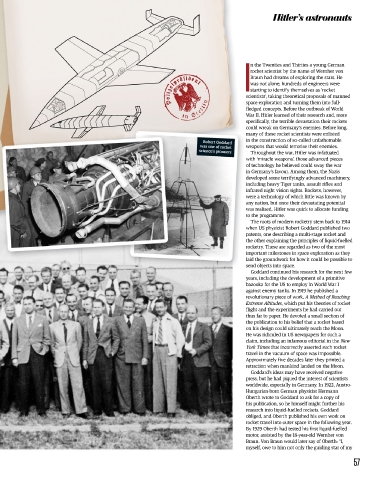
Robert Goddard
was one of rocket weapons that would terrorise their enemies.
Throughout the war, Hitler was infatuated
science’s pioneers
with ‘miracle weapons’, those advanced pieces
of technology he believed could sway the war
in Germany’s favour. Among them, the Nazis
developed some terrifyingly advanced machinery,
including heavy Tiger tanks, assault rifles and
infrared night vision sights. Rockets, however,
any nation, but once their devastating potential
were a technology of which little was known by
was realised, Hitler was quick to allocate funding
to the programme.
The roots of modern rocketry stem back to 1914
when US physicist Robert Goddard published two
patents, one describing a multi-stage rocket and
the other explaining the principles of liquid-fuelled
rocketry. These are regarded as two of the most
important milestones in space exploration as they
laid the groundwork for how it could be possible to
send objects into space.
Goddard continued his research for the next few
years, including the development of a primitive
bazooka for the US to employ in World War I
against enemy tanks. In 1919 he published a
revolutionary piece of work, A Method of Reaching
Extreme Altitudes, which put his theories of rocket
flight and the experiments he had carried out
thus far to paper. He devoted a small section of
the publication to his belief that a rocket based
on his design could ultimately reach the Moon.
He was ridiculed in US newspapers for such a
claim, including an infamous editorial in the New
York Times that incorrectly asserted such rocket
travel in the vacuum of space was impossible.
Approximately five decades later they printed a
retraction when mankind landed on the Moon.
Goddard’s ideas may have received negative
press, but he had piqued the interest of scientists
worldwide, especially in Germany. In 1922, Austro-
Hungarian-born German physicist Hermann
Oberth wrote to Goddard to ask for a copy of
his publication, so he himself might further his
research into liquid-fuelled rockets. Goddard
obliged, and Oberth published his own work on
rocket travel into outer space in the following year.
By 1929 Oberth had tested his first liquid-fuelled
motor, assisted by the 18-year-old Wernher von
Braun. Von Braun would later say of Oberth: “I,
myself, owe to him not only the guiding star of my
57

